Gospel: Jn 11:1-45
There was a certain sick man, Lazarus, of Bethany, the town of Mary and her sister Martha. Mary was the one who anointed the Lord with perfume and wiped his feet with her hair; her brother Lazarus was the sick man. The sisters sent to Jesus and said, “Lord, the one whom you love is sick”. When Jesus heard this, he said, “This sickness is not of death; it is for the glory of God, that the Son of God may be glorified by it.” Jesus loved Martha, her sister and Lazarus. When he heard that he was sick, he stayed two more days in the place where he was. At the end of these days he said to his disciples, “Let us go back to Judea”. The disciples said to him, “Rabbi, the Jews wanted to stone you, and you are going back there? Jesus answered, ”Are not the hours of the day twelve? If one walks by day, he does not stumble, because he sees the light of this world; but if one walks by night, he stumbles, because the light is not in him.“ He said this and added, ”Our friend Lazarus sleeps; but I am going to wake him up.“ His disciples said to him, ”Lord, if he sleeps, he will be healed.“ Jesus had said this of his death, but they thought he was speaking of the rest of sleep. Then Jesus said to them openly, ”Lazarus is dead, and I am glad for your sakes that I was not there, that you may believe. But let us go to him. Thomas, called the Twin, said to the other disciples, “Let us also go and die with him.” When Jesus arrived, he found that Lazarus had already been in the tomb for four days. Bethany was near Jerusalem about fifteen furlongs, and many Jews had come to Martha and Mary's house to console them for their brother. When Martha heard that Jesus had come, she went out to meet him, while Mary remained at home. Martha said to Jesus, “Lord, if you had been here, my brother would not have died. But even now I know that whatever you ask God, God will give you. Jesus said to her, ”Your brother will rise again. Martha said to him, “I know that he will rise again in the resurrection on the last day. Jesus answered her, ”I am the resurrection. He who believes in me, though he die, yet shall he live; and whoever lives and believes in me shall never die. Do you believe this?“ She said to him, ”Yes, Lord, I believe that you are the Christ, the Son of God, the one who was to come into the world.“ Having said this, he went and called his sister Mary and said in her ear, ”The Master is there and is calling you.“ As soon as she heard this, she arose quickly and went to him. He had not yet come to the town, but was still in the place where Martha had found him. The Jews who were with Mary at home comforting her, when they saw that she rose up quickly and went out, followed her, thinking that she was going to the tomb to weep there. Mary came to Jesus, and when she saw him, she fell at his feet and said to him, ”Lord, if you had been here, my brother would not have died“. When Jesus saw her weeping, and the Jews who were with her weeping, he was inwardly moved, and was troubled, and said, ”Where have you laid him?“ They answered him, ”Lord, come and see.“ Jesus burst into tears. The Jews then said, ”See how he loved him.“ But some of them said, ”Could not this man, who opened the eyes of the blind man, have caused this man not to die?“ Then Jesus was moved again inwardly, and went to the tomb. It was a cave, and a stone was laid over it. Jesus said, ”Take away the stone“. Martha, the dead man's sister, said to him, ”Lord, it smells; it is the fourth day. Jesus said to her, “Did I not tell you that if you believe, you will see the glory of God?” So they rolled away the stone. Then Jesus looked up and said, “Father, I thank you that you have heard me. I knew that you always listen to me; but I have said this for the sake of those around me, that they may believe that you have sent me”. When he had said this, he cried out with a loud voice, “Lazarus, come forth. And the dead man came out, bound hand and foot with bandages, and his face wrapped in a shroud. Jesus said to them, ”Unbind him and let him walk.“ Many of the Jews who had come to Mary's house, seeing what he had done, believed in him.
Guidelines for reflection
Martha, Mary, Lazarus. A happy family, a family that had discovered Christ, that had enjoyed his friendship. A common family, with its tensions and its joys. Now that Christ is far away, misfortune strikes. Lazarus falls ill. They send Jesus a warning to come: Martha and Mary recognize that the Lord can do something, that a miracle is possible. Jesus lets time pass, and in Bethany the sad moment of agony arrives. Lazarus leaves. Four days have already passed since he was buried in the tomb. What did Martha and Mary see in Jesus? Why did they call him with few words? Why did they wait for his coming? What did they feel before his silence, his delay? The stone covers the tomb, and the sisters weep, at home, without understanding. The trial of faith can leave very deep wounds. But those who believe know that God can raise even a dead person from the grave.
From pain to hope
Jesus arrives. To human eyes it seems too late. People come and go to comfort the family of the deceased. Martha runs out to meet the Lord and cannot contain the complaint in her heart. She prays as she is, with simplicity, with humility. She prays with her pain and with her tears. She prays from the depths of a heart in need of a grace she does not dare to ask for. And she receives a very special gift: her faith becomes stronger, deeper. She now believes more in Christ, in his salvation, in his love. It is a purified faith, a difficult faith: it is not easy to say yes again when the stone has closed the joys of life. Then Mary arrives. The same complaint, the same sorrow, and the same sincerity. This time Jesus teaches nothing. He is going to act with his eyes fixed on his Father. The miracle will be the response to the clean and loving faith of two women who mourn the death of their brother. How do we react in the trial? To whom do we turn? Where does our prayer go? St. Therese of the Child Jesus teaches us that “prayer is an impulse of the heart, a simple glance thrown heavenward, a cry of recognition and love both from within trial and from within joy.”. Hope is kindled when we look beyond the stars and remember that God is omnipotent, that “his mercy endures forever”, which “his faithfulness lasts forever”, as so many psalms repeat. Even when we have received the blow of death: life and goodness are stronger than pain, failure and any grave.
2. From hope to joy
Jesus manifests himself as the Lord of life and death, as the Lord of history. In an intimate way, to his friends, to those who touch him in deep and sincere prayer, he manifests himself as the faithful Friend. Jesus is capable of raising the dead, of giving sight to the blind, of forgiving sins. We too can touch his heart. We are called to the immense joy of the one who listens: “Your sins are forgiven.”, or who can emerge from the sepulcher of his mediocrity before the command, full of love and strength, of the one who cries out to us: “Go outside!”. The resurrection of Lazarus leaves us surprised. He could have healed his friend before he died, he could have avoided that moment of pain in the family of his friends. However, the Father wanted something else. Jesus accepted God's plan, and he also had to cry. Tears, we know, will be turned into joy (cf. Jn 16,20). We were not born for the grave, but for life. We are not called to sadness, but to the joy of Easter. Do we already have the faces of the risen?
3. From joy to faith
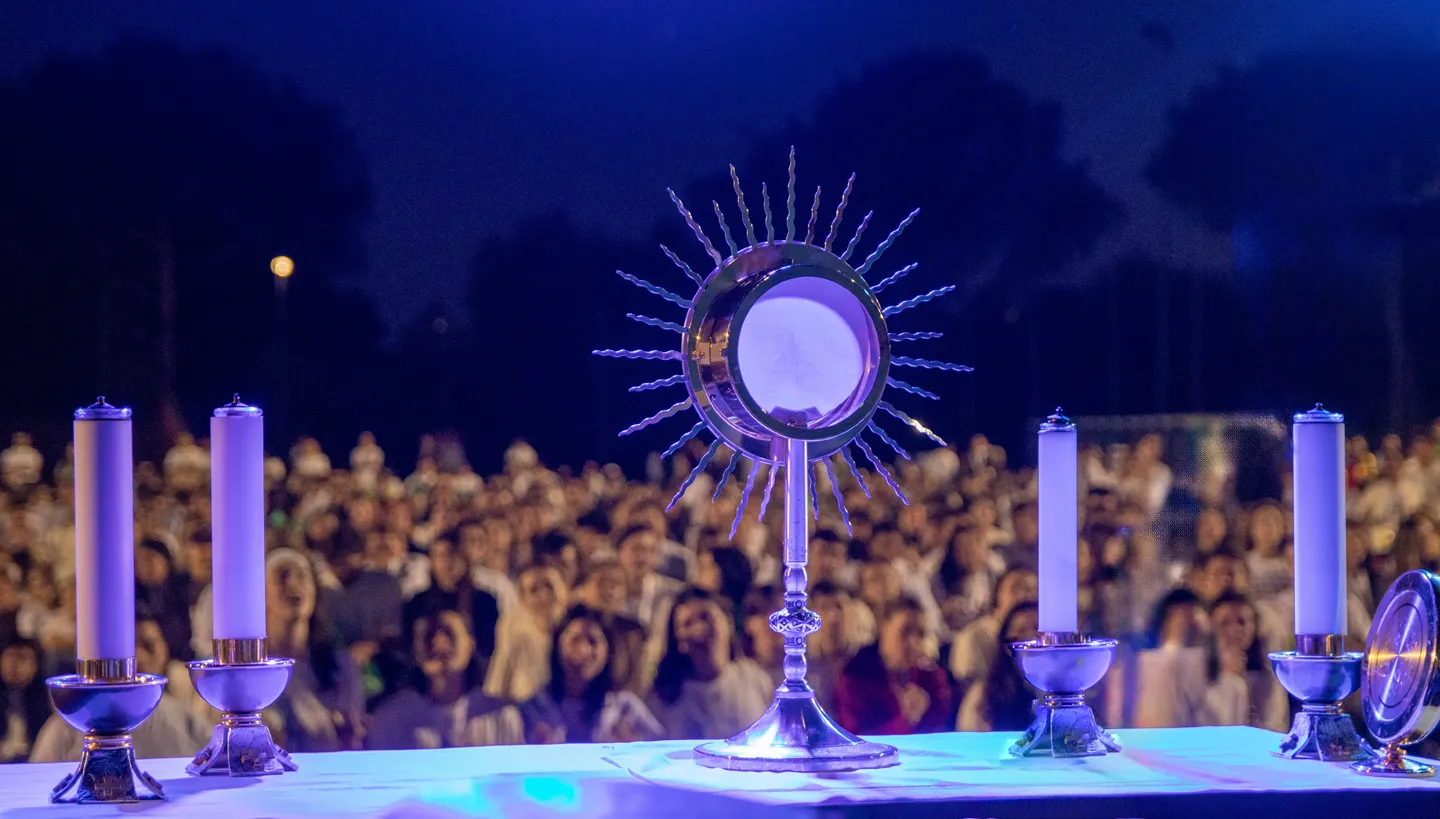
Lazarus is out. He has crossed the border of death. He has come out of the tomb. Some believe. Others, mystery of sin, decide not only to kill Jesus, but also Lazarus. The light shines in the darkness, but only with freedom can we believe. God's gift can become a reason for faith or an occasion for stumbling. God loves us. Lazarus, Martha and Mary know this in a very intimate, familiar way. We, who received more or less some time ago the gift of baptism, know it. Now it is our turn to walk, step by step, towards the day of our definitive encounter with Christ. In the meantime, life will touch us with its joys and sorrows. Jesus seems to be silent, slow to arrive. But we know that he does not leave us alone, that he is with us until the end of the world. In the silence of the Eucharist we can listen to him, we can love him, we can feel him as Friend, Father and Brother. We see and know that he loves us, and that he calls us to a new life. Believing is easy if we love. Believing is easy if we remember the wonders of God in our lives. The great feast of Easter is also for us: God has raised Jesus from the dead, and we believe. Our faith will be a light in the middle of the night, a torch in the darkness of the world, a mustard seed that grows little by little and benefits so many people, a force and instrument of all victories against the world, a faith that rejoices our youth and imprints on our life a noble and ambitious direction, a polarization towards the absolute, which allows us to rescue even the most insignificant crumb of our poor life for the unfading eternity.
Purpose: To analyze what there is in my life that Christ must resurrect, perhaps to come closer to the Eucharist, perhaps to go to confession, perhaps to be more charitable with my neighbor, perhaps something that I must heal in my heart.
Listen to our monthly online retreat.
You may be interested in: Lazarus, the man who died twice.