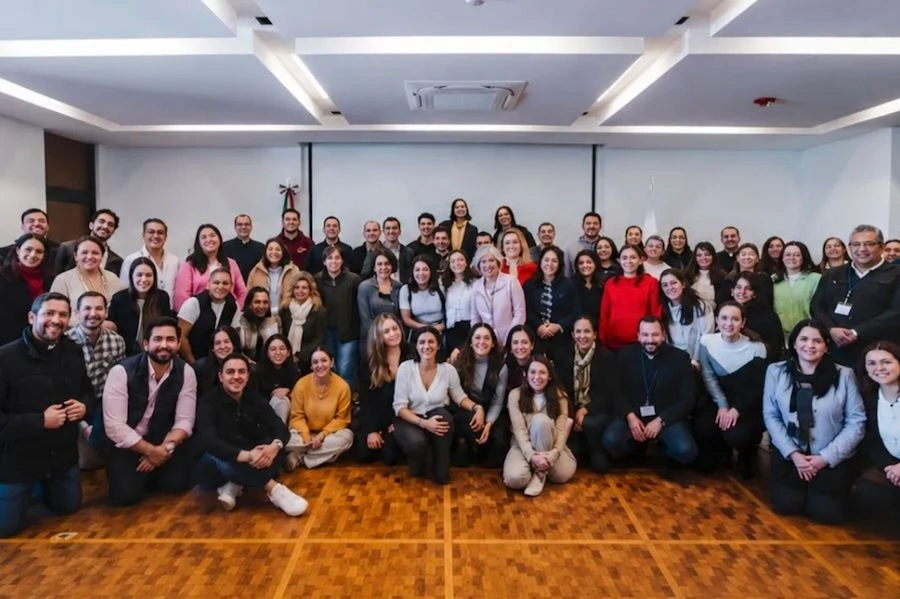
At a time when the university faces the challenge of integrating specialized knowledge with fundamental questions about meaning and the common good, initiatives such as Open Reason take on particular relevance. How can philosophy dialogue with science in the classroom? What place does theology have in the formation of contemporary professionals? The Third International Meeting of Open Reason, held at the Universidad Anáhuac Cancun, brought together participants from different countries with a clear objective: to explore concrete ways to recover the unity of knowledge in university life. A continuation, to presentso the advances, tensions and emerging models that marked the meeting.
It was dthe 27 to 30 of mayo of 2025, that the University Anahuac Cancun, Mexico, hosted the III Meeting of responsibles for Razón Abierta, an initiative of the International University Network Regnum Christi family (RIU). The event brought together academics from ten institutions from three countries to analyze and apply the proposal of «Open Reason» formulated by Benedict XVI, aimed at integrating science, philosophy and theology in university work.
During isis days of work, directors, coordinators and university professors reflected on how this approach can permeate teaching, research and social linkage. The objective was twofold: to review the progress made within the structures The aim is to promote concrete practices that make open reason a transversal axis of educational transformation.

Evolution of the initiative since 2011
The Open Reason proposal has a history dating back to 2011, when Benedict XVI raised the need for. «broadening the horizons of rationality». Since then, the university network has gone through several stages: a rethinking of thego toinstitutional development (2013-2020), a transition to the institutional approach of what was to be achieved (2022), the consolidation of structures and communities (2023-2024), and recently, a maturation process projected towards Cancun 2025. The II Meeting was a key intermediate station, in which progress was evaluated, pilot communities were consolidated and proposals for a future Open Reason congress were formulated.
Open Reason teacher profile
One of the highlights of the meeting was the workshop given by the Instituto Razón Abierta of the Francisco de Vitoria University (UFV), in which the profile of the teacher was defined. from Razon Abierta. This is characterized by questioning the purposes and foundations of their discipline, integrating various branches of knowledge, promoting interdisciplinary dialogue, and encouraging students to be amazed and search for meaning. In addition, the need for collaboration among professors to transform both teaching and research was emphasized.
UFV also presented its institutional framework, where Open Reason is seen as a strategy to overcome the fragmentation of knowledge. Its method is structured around four major questions: anthropological, epistemological, ethical and of meaning. This approach seeks to form academic communities capable of sustaining a more humane science and a more integral education.

Shared best practices
During the space dedicated to best practices, several universities presented projects that integrate the Open Reasoning approach into their academic dynamics. The Anahuac University Mexico shared experiences from his School of the Arts, where art becomes a means of ethical and spiritual reflection. Plays, visual projects and the university choir illustrate how artistic expressions can foster unity, meaning and inner dialogue.
The Anahuac Mayab University highlighted its Cafés Filosóficos, an activity that involves thousands of students around fundamental values through contests, debates and spaces for reflective dialogue. From the Anahuac University Oaxaca a decision laboratory was presented where participants evaluate options from multiple ethical and social dimensions.
At the Anahuac University Cancun, the International School of Design organized the Retrobrunch 2025, a forum on artificial intelligence and design. The discussion focused on how to integrate artificial intelligence and design.ntelligence Artificial without depersonalizing creativity and what role faith, values and reason play in the formation of designers. Also from Cancun, the International Business School presented a formative trajectory where students, from the first semester, adopt Open Reasoning as a style of thinking applied to real business and social dilemmas. At the International School of Architecture, also of Cancun, the Multidisciplinary Integrating Workshop links projects with community impact, addressing social challenges from a technical and humanistic perspective.
The Pontifical Institute Theological John Paul II shared its digital platform «Creative Community», The program is centered on the path of beauty as a pedagogical and communitarian path. For its part, the Anáhuac Puebla University showed how it has begun to articulate communities of humanities professors with an interdisciplinary orientation.

At Anáhuac Veracruz University campus Xalapa, In addition, psychology students make regular visits to a Caritas nursing home, where they practice ethical and thanatological accompaniment. The approach seeks to strengthen their social sensitivity and professional commitment.
Another of the institutions highlighted was the Pontifical Athenaeum Regina Apostolorum, The Rome-based Foundation presented a training program aimed at reinforcing the Christian vision of culture in contemporary contexts. Among its programs are Christianity and Culture in Rome, an immersion in the Christian intellectual tradition, and RESET, a diploma course designed to engage in dialogue with the challenges of postmodern culture. Also offered was the seminar Being a Christian in today's world, based on texts of Joseph Ratzinger, and the summer course APRA Summer, aimed at students of the Anáhuac Network. These initiatives seek to train teachers and students capable of facing current academic challenges from an integrative and open to meaning reason.
New models of academic integration
The UFV Open Reason Institute also presented its curricular transformation model, articulated in four levels: institutional ideology, graduate profile, educational purposes and threshold concepts. This structure seeks to align the academic content with the university mission. In addition, an exercise of legislative analysis of LGTBI laws in Spain was presented, from the four key dimensions of the R methodazon Abierta, as an example of a critical and respectful application of the approach.

At the IEST-Anáhuac, a pilot model was implemented for «Shared Chairs», The first areas to be involved were psychology and architecture. Psychology and Architecture were the first areas involved. The experience was positively valued by more than 85 % of the students, who highlighted its ability to open up new perspectives and enrich the understanding of the human person from different fields of knowledge.
Progress factors and pending challenges
The III Meeting of Open Reason allowed us to identify both strengths and challenges in the implementation process. Among the positive aspects, the rector's commitment, the creation of active academic communities and the exchange of experiences among universities were recognized. The continuous training of teachers and the existence of flexible but rigorous methodologies were also highlighted.
However, obstacles remain, such as the scarcity of time and resources, resistance to change and the need for greater conceptual and methodological precision. To move forward, the consolidation of committees, the allocation of specific budgets and the objective evaluation of impact were proposed. One of the most frequently reiterated calls was to avoid the superficial use of the term «Open Reason», always looking for a real and transforming implementation.
Image credit: Regnum Christi International University Network.