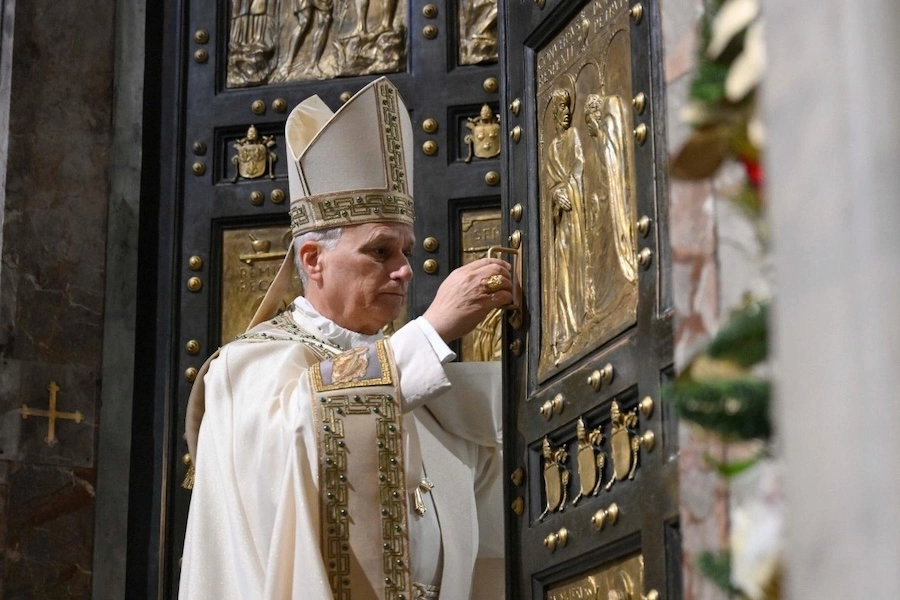
On January 6, 2026, on the Solemnity of the Epiphany of the Lord, Pope Leo XIV presided over the closing of the Holy Door in St. Peter's Basilica, concluding the Jubilee of Hope. The Door has closed, but the mission continues: what remains after crossing it? What is now expected of our communities after a year marked by pilgrimage, conversion and the desire to begin again? The following is the homily he delivered that day:
Dear brothers and sisters:
The Gospel (cf. Mt 2:1-12) details the great joy of the Magi when they saw the star (cf. v. 10), but also the confusion experienced by Herod and by all Jerusalem in their search (cf. v. 3). Whenever it deals with the manifestations of God, Sacred Scripture does not hide such contrasts: joy and confusion, resistance and obedience, fear and desire. Today we celebrate the Epiphany of the Lord, aware that in his presence nothing remains as before. This is the beginning of hope. God reveals himself, and nothing can remain static. A certain kind of tranquility comes to an end, the kind that makes melancholic people repeat: «There is nothing new under the sun» (Qo 1:9). Something begins on which the present and the future depend, as the Prophet announces: «Arise, shine, for your light is coming, and the glory of the Lord shines upon you» (Is 60:1).
It is surprising that it is precisely Jerusalem, the city that witnessed so many new beginnings, that is troubled. In its midst, those who study the Scriptures and think they have all the answers seem to have lost the ability to ask questions and to cultivate desires. Moreover, the city is frightened by those who, moved by hope, come to it from afar, to the point of considering as a threat that which should, on the contrary, cause it great joy. This reaction also challenges us, as Church.
The Holy Door of this Basilica, which today was the last to close, has seen countless men and women pass through, pilgrims of hope, on their way to the City of ever-open doors, the new Jerusalem (cf. Rev 21:25). Who were they and what moved them? At the end of the Jubilee Year, the spiritual quest of our contemporaries, much richer than we can perhaps comprehend, challenges us with particular seriousness. Millions of them have crossed the threshold of the Church. What have they found? What hearts, what attention, what reciprocity? Yes, magicians still exist. They are people who accept the challenge of risking their own journey; who in a complicated world like ours - in many ways exclusive and dangerous - feel the need to set out on a journey, to search.
Homo viator, the ancients used to say. We are lives on the way. The Gospel leads the Church not to fear this dynamism, but to value it and to direct it towards the God who gives rise to it. It is a God who can disconcert us, because we cannot hold him in our hands like the idols of silver and gold, because he is alive and vivifying, like the Child whom Mary held in her arms and whom the Magi adored. Holy places such as cathedrals, basilicas and sanctuaries, which have become the goal of Jubilee pilgrimages, must spread the perfume of life, the indelible sign that another world has begun.
Let us ask ourselves: is there life in our Church? Is there room for what is born? Do we love and proclaim a God who sets us on a journey?
In the story, Herod fears for his throne, he is agitated by what is beyond his control. He tries to take advantage of the magi's desire by manipulating their quest to his own advantage. He is ready to lie, he is ready for anything; fear, indeed, blinds. The joy of the Gospel, on the other hand, liberates; it makes us prudent, yes, but also audacious, attentive and creative; it suggests paths different from those we have already traveled.
The Magi bring to Jerusalem a simple and essential question: «Where is the King of the Jews, who has just been born? How important it is that whoever crosses the door of the Church should realize that the Messiah has just been born there, that a community is gathered there where hope has arisen, that a life story is being realized there. The Jubilee has come to remind us that we can begin again, indeed, that we are still at the beginning, that the Lord wants to grow among us, wants to be God-with-us. Yes, God questions the existing order; he has dreams that inspire his prophets even today; he is determined to rescue us from old and new slaveries; in his works of mercy, in the wonders of his justice, he involves young and old, poor and rich, men and women, saints and sinners. Noiselessly, however, his Kingdom is already springing up all over the world.
How many epiphanies have been given to us or will be given to us! But they must be kept away from Herod's intentions, from the fears that are always lying in wait to transform themselves into aggression. «From the time of John the Baptist until now, the Kingdom of Heaven has been violently fought against, and the violent are trying to take it away» (Mt 11:12). This mysterious expression of Jesus, quoted in the Gospel of Matthew, makes us think of the many conflicts with which people can resist and even attack the Newness that God has reserved for all. To love peace, to seek peace, means to protect what is holy and that is precisely why it is being born: small, delicate and fragile as a child. All around us, a distorted economy tries to profit from everything. We see it: the market transforms into business even the human thirst to search, to travel and to begin again. Let us ask ourselves: has the Jubilee educated us to flee from this kind of efficiency that reduces everything to a product and the human being to a consumer? After this year, will we be more capable of recognizing in the visitor a pilgrim, in the stranger a seeker, in the distant a neighbor, in the different a fellow traveler?
The way in which Jesus went out to meet everyone and allowed everyone to approach him teaches us to appreciate the secret of hearts that only he knows how to read. With him we learn to grasp the signs of the times (cf. Ecumenical Council Vat. II, Pastoral Constitution Gaudium et Spes, 4). No one can sell this to us. The Child whom the Magi adore is a Good that has neither price nor measure. He is the Epiphany of gratuitousness. He does not wait for us in prestigious places, but in humble realities. «And you, Bethlehem, land of Judah, are certainly not the least among the chief cities of Judah» (Mt 2:6). How many cities, how many communities need to be told: “Surely you are not the least”. Yes, the Lord continues to surprise us! He allows himself to be found. His ways are not our ways, and the violent cannot dominate them, nor can the powers of the world obstruct them. Herein lies the great joy of the Magi, who leave behind the palace and the temple to go to Bethlehem; and it is then that they see the star again!
Therefore, dear brothers and sisters, it is beautiful to become pilgrims of hope. And it is beautiful to continue to be so, together. God's faithfulness will always surprise us. If we do not reduce our churches to monuments, if our communities become homes, if we reject together the blandishments of the powerful, then we will be the generation of the dawn. Mary, Star of the morning, will always walk before us. In her Son we will contemplate and serve a magnificent humanity, transformed not by delusions of omnipotence, but by the God who became flesh out of love.
Cover image credit: Vatican News.