Mariana Ibáñez Díez is the current territorial director of the Consecrated Women of Regnum Christi of the territory of Europa. At l. next interview tells us dehe discernment, an attitude towards life, an inner willingness to listen and a sincere desire to find out where it is going. God in our history. No as a but an activity of love that seeks to achieve the «more». In a fast-paced culture, discernment may seem impractical, but it is an act of love that leads to more conscious decisions. Jesus himself discerned by listening to the Father. To live it out in daily life, Mariana recommends working on interiority, refreshing the memory of the heart, remaining in conversion and fostering conversations in the Spirit.
«We want each locality to assume the responsibility of discerning its own reality in order to discover the Kingdom of Christ present there and make it emerge, and to decide locally the concrete way to carry out the mission. Faithful to the charism we have received, we seek to adapt the methods and procedures to the diversity of the ways.» (Communiqué of the 2024 Ordinary General Convention).
What is discernment?
I would not dare, in a brief space such as this, to explain in depth what discernment means. It would be pretentious, especially considering that so many saints, Christian authors - and even secular authors - have dedicated entire pages to trying to illuminate this reality. Even so, perhaps I can offer some simple guidelines to help us approach this mystery, not as a technique, a methodology or a recipe, but rather as an attitude towards lifeIt is a way of being, a way of being truly “present”, an interior disposition to listen, and a sincere desire to discover where the Lord is going in our history.
It is a statement of our relational essence, of the knowledge that we are deeply linked with “Someone” who loves us, knows us, dreams of us, sends us and calls us to fulfill ourselves in encounter and communion with others. Deep down, to discern is to enter into a dynamic in which we give back to God the initiative: we ask Him questions, we ask Him to reveal Himself to us, and we remain attentive to the mediations through which He speaks to us: conscience, the Word, reality, the voice of our brothers and sisters, the face of the poor....…
This attitude towards life, as the final document of the Synod rightly points out, also presupposes “interior freedom, humility, prayer, mutual trust, openness to novelty and abandonment to the will of God” (no. 82). Basically, it is an attitude of love, which springs from love, and leads to love. It is to live connected with the deepest and most fundamental longings that we carry in our hearts. One of the definitions of discernment that I like the most and that has marked me deeply is the following: «Discernment is a movement or activity of love that seeks the “more”. Inherent to authentic love because all authentic love seeks more: more to love, more to serve, more to help, more to please, more to identify oneself... Authentic and living love is dynamic and discernment is part of that dynamic inherent to love. Discernment is the activity of seeking how to love more and better, how to be more successful in love, how to identify oneself more with the One whom one loves above all else.» (Dario Mollá Llacer, sj. Former Provincial Superior of the Aragon Province of the Jesuits. CONFER Magazine, Volume 43. Number 167, pp 471-485).

And here I make a link with our own spirituality: if the greatest desire of the apostle of the Kingdom is that Christ may reign in hearts, then we seek that little by little our hearts may be configured with His and that our hearts may be configured with His. «we allow ourselves to be penetrated by the love of Christ for humanity». (Federation Statutes No. 13), in a deep desire to identify ourselves with the Heart that has loved the most, has pleased its Father the most, has spent its entire life doing Good.
How can someone live discernment in a society that rewards more efficient accelerated responses?
I would say that it is true that today's society tends to impose on us an accelerated pace, and gives the impression that the immediate, the fast and the efficient are valued. However, it is also true that this haste often leads us to confusion, to emptiness, and what seems to guide us towards efficiency ends up leaving traces of nervousness, dissatisfaction and superficiality.
I understand that discernment might seem, at first glance, as a process that slows down decisions or as a process that belongs exclusively to the realm of the spiritual life or as something that is done only at certain moments or stages of life. But, in reality, when lived well, it acts as a true catalyst. If we want to use that language, we could say that discernment brings a “greater efficiency”, This is because it leads to more conscious, more integrated decisions, with greater understanding of the factors involved and, therefore, more oriented to a good result. In addition, a person who exercises in discernment remains in a certain inner dynamism, more “awake”, more attentive to perceive what is happening around him.
In any case, I believe that the best response to this tension between speed, efficacy and depth is given to us by Jesus himself through the mystery of the Incarnation: The eternal, infinite and all-powerful God decides to enter the world, to embrace human nature, to assume the limits of time, of rhythm, of doing, of physical coordinates. God himself, in order to “achieve the greatest triumph” -our redemption- chooses a specific path: Jesus. With his life, his words and his decisions, he introduces us to a completely different logic: the logic of the Kingdom. A logic that values time, the small, the fragile, waiting, service... a dynamism that breaks with the prerogatives and demands that often overwhelm or condition us.
In the same vein, Henri Nouwen, in his book Signs of life, makes a precious distinction between fruitfulness and productivity. He says that living a fruitful life-not necessarily successful or productive in worldly terms-involves being open to the mystery of life, vulnerability and patience. Productivity may reflect our attempt to control everything, while fruitfulness manifests itself when we dare to let life speak to us from within, with its own rhythms. Fruitfulness, as a quality of love, belongs to the realm of the unpredictable, the indefinable and the gratuitous. In this sense, the No. 9 of the Federation's Statutes remind us that the Kingdom of Christ is a gift and cannot be built by human strength alone, and therefore we seek to remain always in communion with Christ and his Church, like the branch in the vine (cf. Jn 15, 5). And the Final Communiqué of the General Convention of the Regnum Christi contains prophetic seeds and profoundly significant messages that, as members of the Regnum Christi family, We are called to unravel, incarnate and bring to life little by little. He warns us of this precise sophistry by mentioning it as a temptation for the apostle who, perhaps seeking acceptance, recognition, success, forgets that “although we are in the world, we belong to Christ”, and invites us to recognize the primacy of supernatural means to guide our apostolic mission.
How to find a balance so as not to fall into the dedication trap little time to discern because it implies stopping, analyzing, creating spaces for reflection, and, even if it can become tiring?
It is worthwhile to take life with depth and awareness, trying to live it with authenticity. When we recognize that life is a gift, that time, talents, dreams and desires for good are also gifts, then we begin to live with our feet on the ground, but with the heart open to the horizon, seeking to find perspective. Discernment implies just that: to stop, to take a distance, to recognize that what we are carrying in our hands does not belong to us, that we are not managing a company or executing our own project. It requires humility to know that we are bearers of something that surpasses us, servants in the Lord's vineyard... a vineyard that is His, and that He mercifully entrusts it to us.
For this reason, discernment is born of an attitude of humility, realism, attentive listening and sincere recognition of our fragility. It is true that living with this openness to the voice of the Lord can seem tiring or impractical, especially in a fast-paced culture. But I would dare to say that often the real weariness does not come from discernment, but from the fatigue that comes from acting without clarity, from remaining anchored in one's own opinion, without opening oneself to consensus in the midst of unresolved tensions.
So we could say that “waste time discerning” is an act of love and perhaps the greatest service we can provide in order to respond faithfully to the Church's mission. This is what the Gaudium et Spes Nº4: «In order to fulfill this mission, it is the Church's constant duty to scrutinize the signs of the times and to interpret them in the light of the Gospel, so that, adapting herself to each generation, the Church can respond to the perennial questions of humanity about the meaning of the present life and of the life to come and about the mutual relationship between the two. It is therefore necessary to know and understand the world in which we live, its hopes and aspirations, and the dramatic bias which often characterizes it.».
The final document of the recent Synod For a Synodal Church: Communion, Participation and Mission clearly underlines that the synodality is an essential and inseparable dimension of the Church. Along the way, the Church is acquiring an ever deeper awareness of what this reality implies. As the document itself points out: «The synodality... mission-oriented, involves gathering in assembly at the different levels of ecclesial life, mutual listening, dialogue, community discernment, reaching consensus as an expression of the presence of Christ in the Spirit, and decision making in a differentiated co-responsibility.» (n. 28, Final Document of the Second Session of the XVI Ordinary General Assembly of the Synod of Bishops). If the synodality is part of the very being of the Church, then it is key that each of its members assume it with seriousness and commitment, learning to live as a “discerning subject” at the service of a Church that walks together, listens, and seeks together the will of God.
How to know the moment to act, to take the step, without extending the discernment more than necessary?
In addition to the aforementioned, discernment should be understood as a style and attitude towards life that is not limited to a specific moment or a specific action, but rather as a way of life that is not limited to a specific moment or a specific action, but rather as a way of life that is not limited to a specific moment or a specific action. that encompasses the totality of existence. It is a life transfigured by those who wish to live it in its fullness: a life received and shared, a mission received and given. In this sense, discernment is not an end in itself, but a means that guides us in the search for the best way to act, to echo the heart of God. Therefore, I would not see a contradiction or exclusion between discerning and acting, but rather that discernment is necessary to act better, to decide more clearly, to live more fully and to love more.
The synod document also addresses ecclesial discernment, linked to other means that facilitate the journey, such as the care of decision-making processes, the commitment to be accountable for the work done and the evaluation of the results of what has been decided. In this context, it is explained that these three practices are deeply related: «Decision-making processes require ecclesial discernment, which demands listening in a climate of trust, favored by transparency and accountability. Trust must be reciprocal: decision-makers must be able to trust and listen to the People of God, who in turn must trust those who exercise authority. This holistic vision underscores that each of these practices are mutually dependent and mutually supportive, serving the Church's ability to fulfill its mission.» (No. 80).
What means do you recommend for discernment in daily life??
In addition to familiarity with the Word of God and proximity to the Eucharist, the following ways could help:
Contemplating the life of Jesus from the perspective of discernment
He is the one who gives life and depth to the expression of the Shema “listen” Israel. His life itself is a continuous act of discernment, in which, listening to the voice of the Father, he directs his whole existence towards the good, always seeking to please him in every thought, word and deed. We see this, for example, when he withdraws to pray on the mountain before making important decisions, such as the choice of his first disciples, or when he allows himself to be led into the desert by the Spirit. We also see it in his ability to stop in the face of the unexpected: as when he allows himself to be interrupted by the woman who touches his cloak and causes a miracle, even though he was on his way to Jairus' house. Or when, before the woman accused of adultery, he takes a moment of silence while writing in the sand, before responding with wisdom and mercy. His attentive and loving gaze towards each person, sometimes acting with a miracle and at other times simply with a word or a presence. Each episode of his life reveals to us his deep sensitivity and desire to listen to the Father at all times.
Refreshing the heart's memory
One of the most practical ways to do this is to remember that God is always present, he walks among us, he acts in our lives and nothing escapes him. There is “theological places” very close where He speaks to us. One way to connect with this is to look for specific moments to make a “prayerful reading” or a “review” of what the Lord is doing in our lives. It is a practice ignaciana that helps us to discover God's blessings in the everyday, observing what is moving within us. At the same time, we can learn to recognize the fruits of the Spirit that emerge through discernment: deep peace, lasting joy, burning love.
Working on interiority
Transformation is born in the depths of the heart, the growth of the Kingdom of God begins from within and goes outward from within. It is in interiority that the Kingdom finds fertile ground to grow by itself. But we tend to live more on the periphery, in the immediate, in the sphere of worldly concerns, distractions, false promises. Interiority, unlike weeds (individualism, protagonism, distrust, vanity...), does not grow by itself: it must be cultivated. For this reason, to work interiority is also to cultivate —as in a garden— that discerning style we talked about at the beginning. It's about staying fresh, soft, permeable... “in the form of” to acquire a familiarity with the Lord and rest our heart in Him.
Remaining in continuous conversion
To turn our face to God again and again, to refocus our gaze, to recognize our distractions and, with humility, to redirect ourselves towards Him. Life is dynamic, and precisely for this reason we are called to seek, at every moment, the concrete way to respond to God from our daily reality. In this context, it is important to remember that evil is not discerned, but simply avoided. Discernment does not move primarily in the realm of morality, but in a more subtle and profound dimension: that which asks with honesty and openness what is best for me today, what option brings me closer to my goal, to my founding desires, to my fullness, to God.
Encourage group “conversations in the Spirit”.”
These are very well described in the No. 45 of the final document of the Synod. They are spaces in which one does not only share what one thinks, nor reaffirm one's own position, but also what one prays, what one discerns in one's heart. They are conversations that help in moments of preparing for a decision, of dealing adequately with a conflict or a conflict of faith. “knot”, to be able to dispose the group for a “next possible step”. These are extraordinary occasions to exercise attentive listening, to become familiar with the voice of the Lord who speaks and manifests himself in the midst of the group, and thus allow the community to be built from the deep, the vulnerable and the authentic.
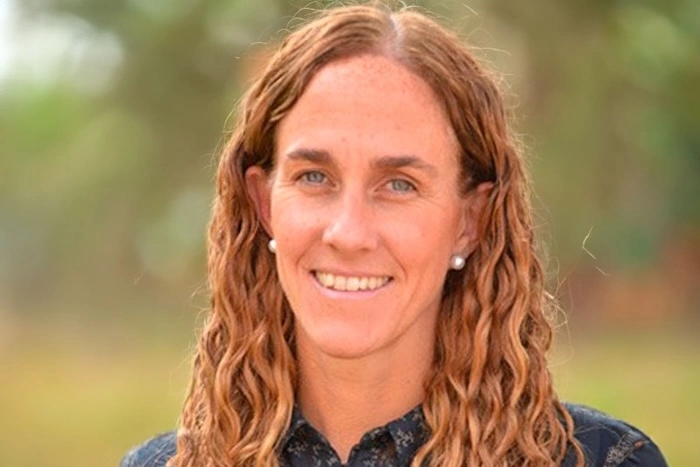
Mariana Ibáñez Díez, was born on October 28, 1971 in Mexico, from a Spanish family & the youngest of three siblings. She was consecrated God in the Regnum Christi family August 24, 1992 and is currently the territorial director for the consecrated women in the territory of Europa.