Can I study exorcism and deliverance prayer? Yes, as long as you meet certain requirements. The Regina Pontifical Athenaeum Apostolorum of Rome, presents its XIX edition of the course on the ministry of exorcism and prayer for deliverance, aimed at priests, lay people and members of other religious confessions.
The course is face-to-face, will be held from May 12 to 16, 2025 and registration will be open until May 5. The program is performs in collaboration with the Socio-Religious Research and Information Group (GRIS) of Bologna and will systematically address the anthropological, phenomenological, social, theological, liturgical, canonical, pastoral, spiritual, medical, neuroscientific, pharmacological, symbolic, criminological, legal and juridical aspects of the ministry of exorcism and deliverance prayer. The course will be held in Italian with simultaneous translation into English and Spanish.
Who can access the course?
Catholic priests with a “celebret” in force and, in the event that the “celebret” If you have no expiration date, a letter of recommendation from your bishop or superior is required.
Lay Catholics with a letter of authorization to take the course from an ecclesiastical authority, signed by the bishop of the diocese or by a priest. Catholic, endorsed & sealed by the bishop. They also need to submit a statement explaining the intention and reasons why they wish to participate in the course.
Lay people and clergy of other religious denominations who present a letter of authorization from a Catholic ecclesiastical authority. and a statement explaining their intention and reasons for wishing to participate in the course, as explained in document «Norms for the application of the Apostolic Constitution Veritatis Gaudium», Section IV, Art. 26 §1.1: «With respect to non-Catholic students, they may be admitted to an Institute of Ecclesiastical Studies only after a written presentation from a Catholic Ecclesiastical Authority guaranteeing their moral rectitude and benevolent disposition towards the Church».
Everyone must fill out a registration form that can be done online, on the Ateneo's website.
Curing the Jubilee Year, this year the course will conclude with a special event: the passage through the Holy Door and the celebration of the Holy Mass in St. Peter's Basilica, scheduled for the following day.Saturday, May 17, at 11:00 a.m. (Rome time). It will be a moment of recollection and prayer for those who wish to conclude the formative journey with a solemn Jubilee celebration.
To learn more about the course, its registration forms and cost, go to this link.
Clarifying the terms
What is the difference between an exorcism and a deliverance prayer? In the teaching of the Catholic Church, both exorcism and the prayer of deliverance are practices spiritual to combat the influence of the Maligno, but differ in their nature, authority and application.
According to the Catechism of the Catholic Church, «When the Church publicly and authoritatively asks, in the name of Jesus Christ, that a person or an object be protected against the wiles of the Evil One and be removed from his dominion, we speak ofexorcism. Jesus practiced it (cf Mc1:25-26; etc.), from Him the Church has the power and the office of exorcising (cf Mc3,15; 6,7.13; 16,17). In simple form, exorcism takes place in the celebration of Baptism. The solemn exorcism called “the great exorcism” can only be practiced by a priest and with the permission of the bishop. In these cases it is necessary to proceed with prudence, strictly observing the rules established by the Church. Exorcism attempts to expel demons or to liberate from demonic dominion thanks to the spiritual authority that Jesus has entrusted to his Church. Quite different is the case of illnesses, especially psychic ones, whose care belongs to medical science. It is therefore important to make sure, before celebrating an exorcism, that it is a question of a. presence of the Evil One and not of a disease» (CCC n. 1673).
As for the prayer of deliverance, it is within the practices of prayer and blessings that the Church uses to ask for protection and deliverance from evil influences, albeit without the formal structure and specific authority of a solemn exorcism. Unlike exorcism, which can only be performed by a priest authorized by his bishop, the prayer for deliverance pcan be carried out by a priest, consecrated person, seminarian i any Christian faithful, either individually or as a community, and does not require special authorization. These prayers seek the relief and protection of the affected person, trusting in the mercy and power of God..
It is essential to understander these differences to adequately address adverse spiritual situations, always under the guidance and teaching of the Church. and, above all, to be well trained in order not to fall into excesses or even doctrinal deviations.
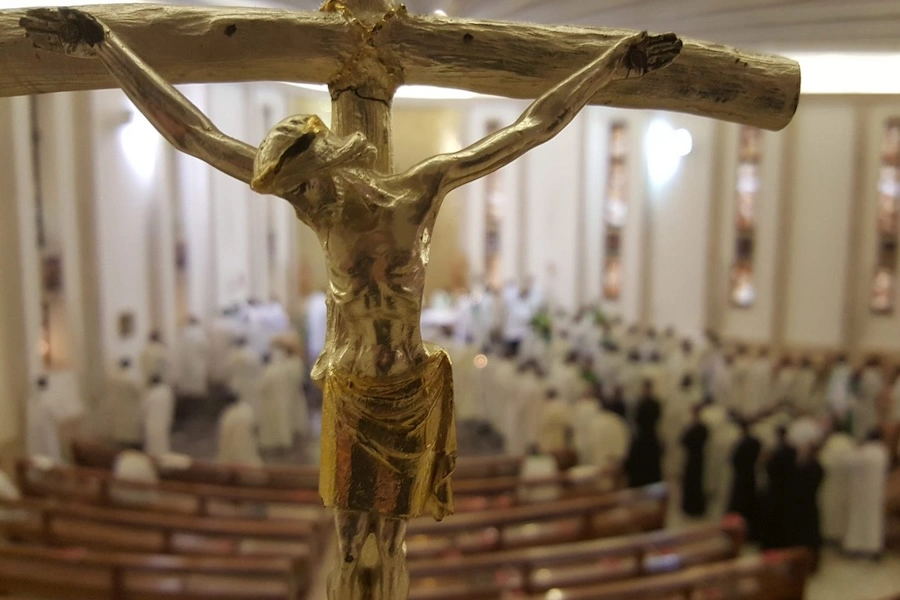
(Cover image: chapel of the Legionaries of Christ International School, Colegio Internacional Legionarios de Cristo., of Rome)