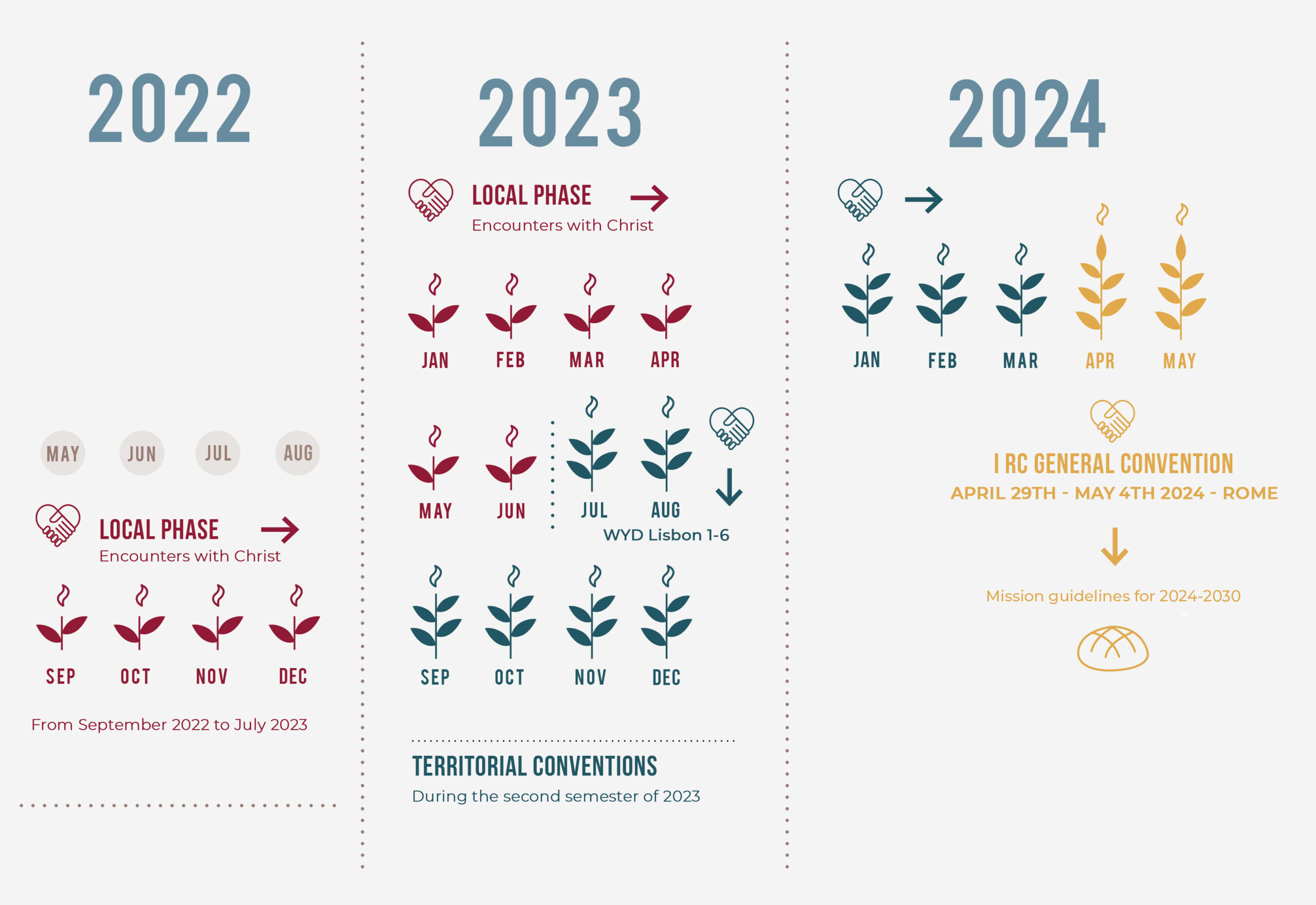
Documents ofthe general convention 2024
Download the complete guide to all 8 topics
Versión en español
English version
Versione italiana
Version française
Versão em português
Download the Guide for Reflection on the Identity of the Lay Members of Regnum Christi
Versión en español
English version
Versione italiana
Letters for the general phase
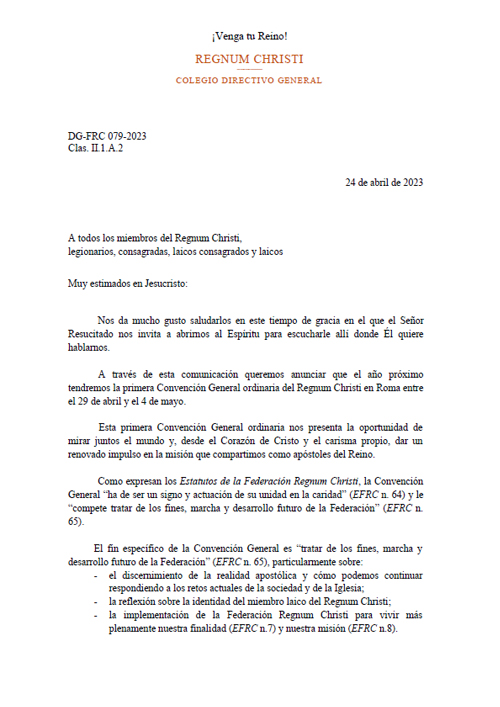
Through this announcement, we would like to inform you that next year we will hold the first Ordinary General Convention of Regnum Christi in Rome from April 29 to May 4. This first Ordinary General Convention offers us the opportunity to look at the world together and, from the Heart of Christ and our own charism, give renewed impetus to the mission we share as apostles of the Kingdom.
Letters for the local phase
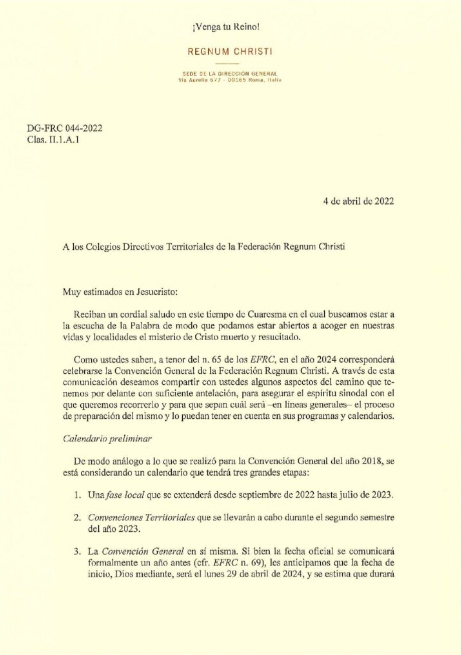
Through this communication we wish to share with you some aspects of the road ahead of us… to ensure the synodal spirit with which we wish to travel it and to let you know what will be the preparation for it.
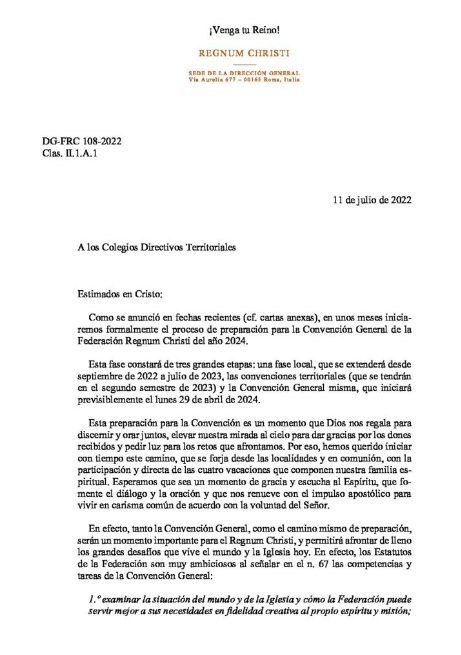
We thought it appropriate to set up a committee to closely follow this process, starting from the structure and members of the General Board of Directors and the work teams, supported by an executive secretariat.
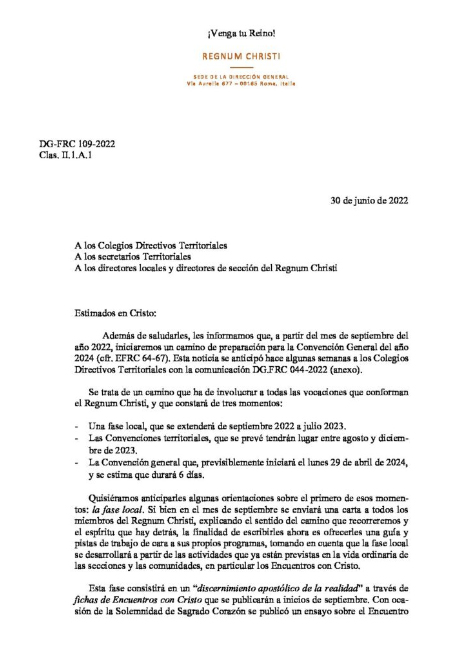
What objectives and fruits are sought in this journey of preparation for the Convention? We hope that it will be part of the broader journey of renewal and promotion of the life and mission of Regnum Christi that we have been making in recent years.
We do not simply want to promote an intellectual analysis, but to foster a dynamic of discernment in our own localities. Therefore, the proposed emphasis is to look at the needs of the world and the Church, from the heart of the apostle of the Kingdom.
No queremos simplemente promover un análisis a nivel intelectual, sino fomentar una dinámica de discernimiento en las propias localidades. Por ello, el énfasis que se propone es el de poner la mirada en las necesidades del mundo y la Iglesia, desde el corazón del apóstol del Reino.
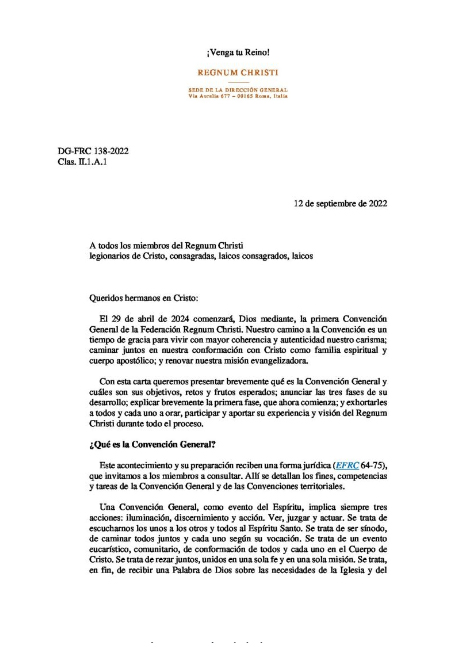
Con esta carta queremos presentar brevemente qué es la Convención General y cuáles son sus objetivos, retos y frutos esperados; anunciar las tres fases de su desarrollo; explicar brevemente la primera fase, que ahora comienza; y exhortarles a todos y cada uno a orar, participar y aportar su experiencia y visión del Regnum Christi durante todo el proceso.
Local phase resources
Guide for Reflection on the Identity of the Lay Members of Regnum Christi

As part of the journey of discernment leading up to the 2024 General Convention, the lay members of Regnum Christi feel called to reflect more deeply on our identity and mission and on our vocation in Regnum Christi. We want to understand what our role is, not only in the Church but, in a particular way, in our spirituaal family in the light of the Gospel, ecclesial documents and our charism.
This is why, just as we are participating with the other vocations of Regnum Christi in an apostolic discernment of reality, we also want to take a moment and listen to the Holy Spirit in order to understand what specifically he calls us to as laity in the world and in Regnum Christi.
This guide seeks to be a tool to help with this reflection.
It is recommended that this activity be carried out by teams of lay members, whether encounter teams within a section, or apostolate teams. Although this activity does not follow an Encounter with Christ methodology, it can replace one of the Encounters with Christ foreseen in the teams’ regular activities.
Download the Guide for Reflection on the Identity of the Lay Members of Regnum Christi
Print or continue reading from your computer or device.
Discussion Guide 1: Proclamation of the faith and the new evangelization

The Gospel is the Good News, it is the proclamation of Jesus Christ who enters the history of humanity. This Good News has in itself a special power to call and convict, because it is the bearer of what it offers and proclaims: the possibility of a totally new life that is transformed by personal adhesion to the resurrected Jesus Christ, Son of God and Savior of humanity.
All Christians have been called and invited to proclaim this Good News with our lives. Jesus Christ, who comes out to meet us and reveals the love of his heart to us, sends us to our brothers and sisters. It is a matter of proposing the truth of Jesus Christ who comes to establish his Kingdom with our actions and our words, in a convincing and attractive way.
Members of Regnum Christi, impelled by the personal experience of Christ’s love, feel the interior urgency of making present his Kingdom, giving witness to what we have lived and experienced, and seeking to respond to the needs of the world and the Church.
Download Discussion Guide 1
Print or continue reading from your computer or device.
Discussion Guide 2: Christian formation and the education of children

The witness of Christian life given by parents in the family comes to children with tenderness and parental respect. Children thus perceive and joyously live the closeness of God and of Jesus made manifest by their parents in such a way that this first Christian experience frequently leaves decisive traces which last throughout life.
This childhood religious awakening which takes place in the family is irreplaceable (Cfr. General Directory for Catechesis, n. 226, 2020).
The child perceives, absorbs, explores, examines, becomes self-aware through experiences. They have a great capacity for wonder, for openness to mystery, for grasping supernatural realities in their interior (the presence of their Guardian Angel, of the Blessed Virgin…). They live the joy of encountering God with simple and spontaneous acts and signs in front of beautiful images which reflect the tenderness of the Blessed Virgin, of St. Joseph, and of the Child Jesus.
Download Discussion Guide 2
Print or continue reading from your computer or device.
Discussion Guide 3: Christian formation and education of adolescents

Jesus Christ, God incarnate, passed through every stage of life that we ourselves live: infancy, adolescence, youth, and adulthood. However, we have very few passages in the Gospels about his adolescence that tell us about his life in those years. The Gospel of Luke affirms that when Jesus was twelve he lived in Nazareth, Obedient to his parents, and grew in wisdom, stature, and grace before God and men (Luke 2:52).
This brief description speaks to us of how he lived this time which is crucial in the life of a person.
Adolescence is the stage of life in which one begins to decide who we want to be and how we want to live, which constitutes an important moment with regards to evangelization.
As an existential time that is characterized by an intensity of desires and experiences, it is necessary to teach adolescents to channel all the strength of their questions and longings. The values of their infancy are no longer sufficient, because they need greater understanding and depth in order to be able to choose them freely. In this sense, they also need a new and more personal experience of Christ and of the Church in order to persevere on this path.
Download Discussion Guide 3
Print or continue reading from your computer or device.
Discussion Guide 4: Christian formation of youth
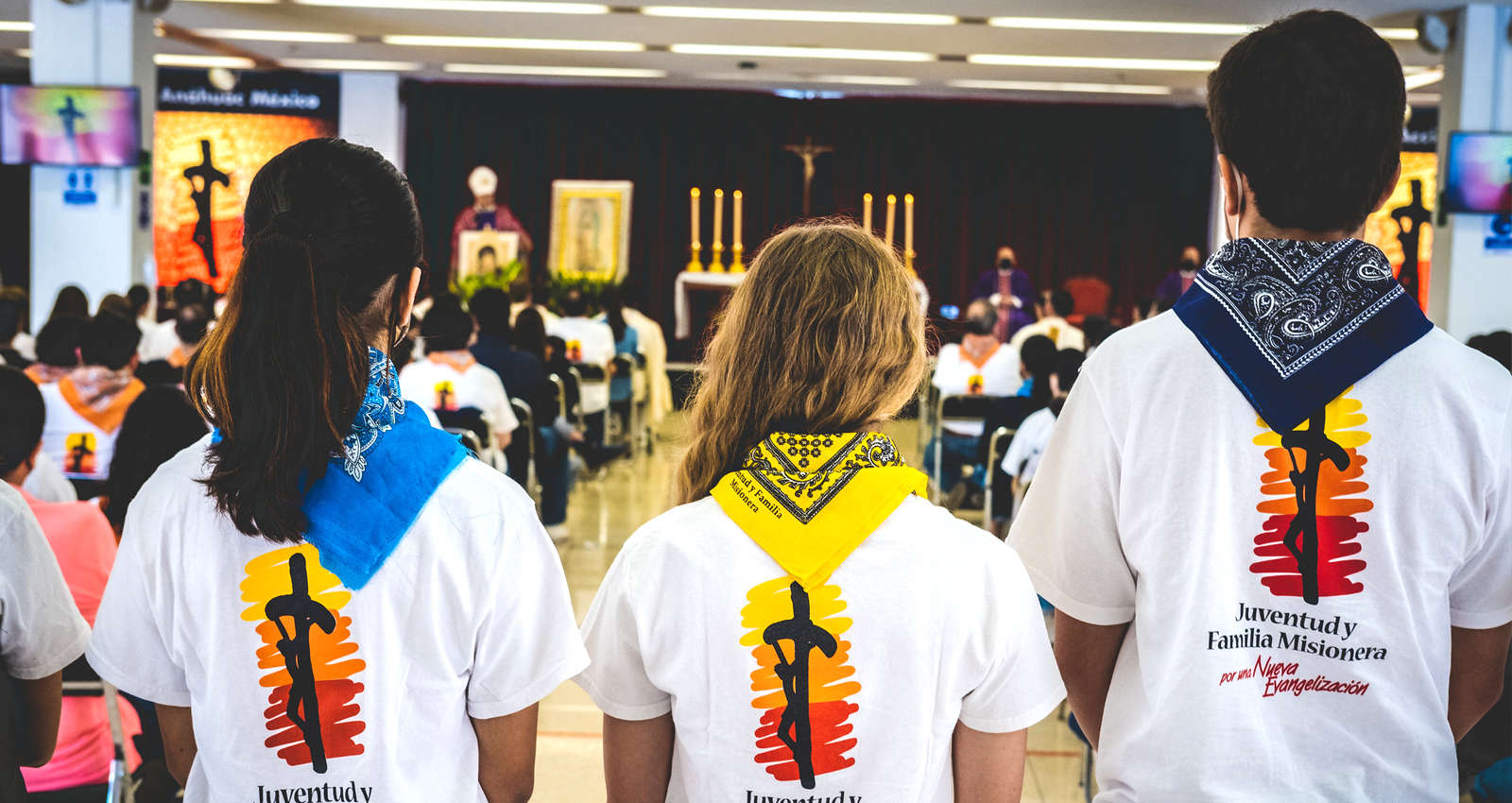
“Youth is an original and stimulating stage of life, which Jesus himself experienced, thereby sanctifying it”. (Christus Vivit 22)
This is the stage of discovery, of ideals, of the future which is built in the present. It is the moment to lay foundations, to have an experience of a close God who wants you to be happy and who is always with you. The stage of understanding, of comprehending a living God present in the world and in daily life.
Youth are on the path of discovering a faith that has meaning, not merely theoretical, but applicable to life. A faith that allows him or her to progress and begin a path of deep and lasting happiness. Like the Samaritan woman, they seek water that can fully satisfy them.
Allowing Jesus to accompany and know them deeply in this stage profoundly marks their hearts and lives.
Download Discussion Guide 4
Print or continue reading from your computer or device.
Discussion Guide 5: Marriage and family
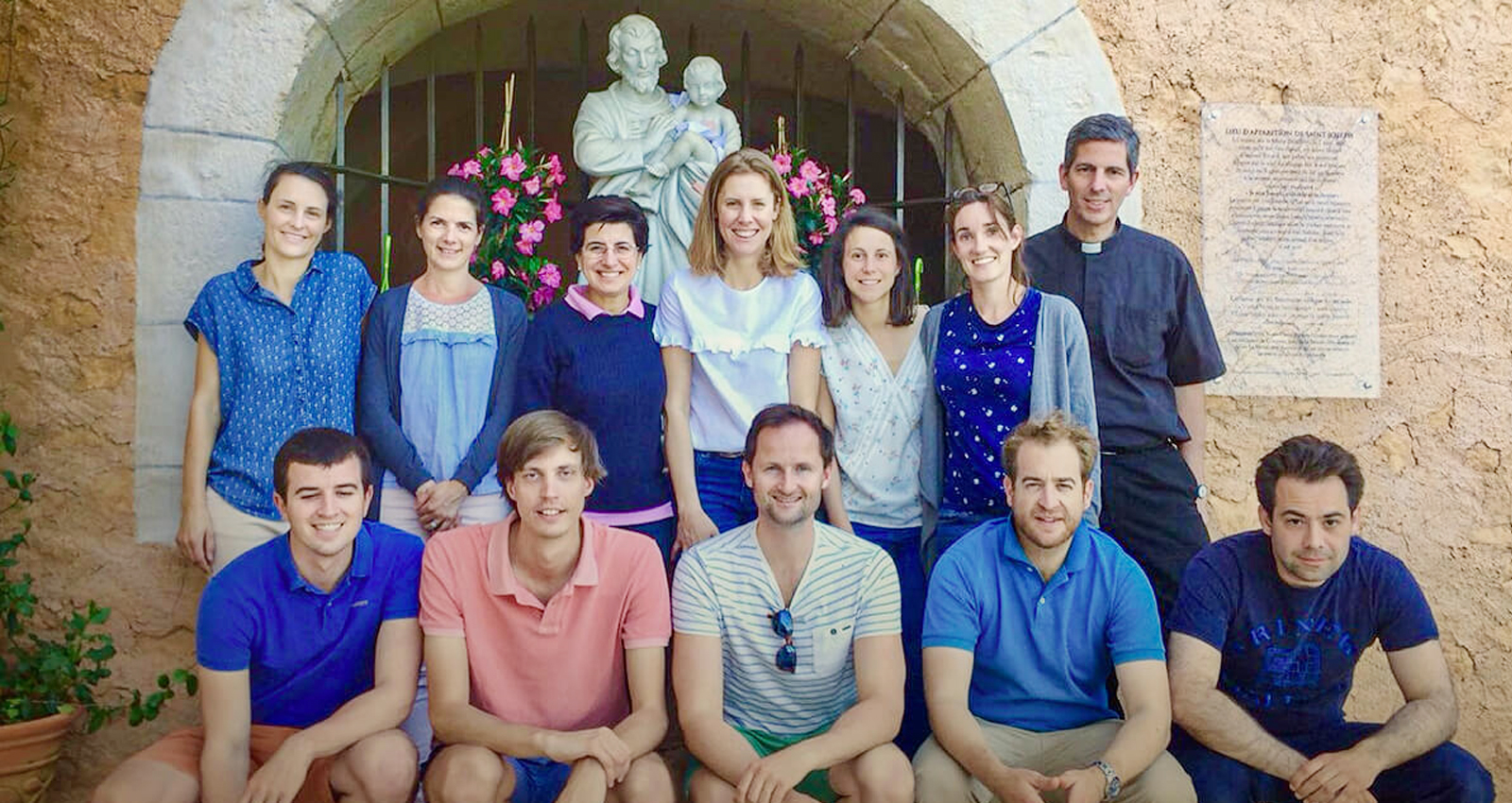
Download Discussion Guide 5
Print or continue reading from your computer or device.
Discussion Guide 6: Vocational culture and ministry
- The understanding of the Church as the pilgrim people of God and as the community of the baptized in which each individual has received a gratuitious call of God’s love and has been sent as a response to the evangelizing needs of the world today.
- The universal call to holiness, and, consequently, the appreciation for the vocation of the laity. The Church is therefore understood as a body with different members (see 1 Cor 12:12), with different gifts which must be given a place, since everyone contributes to the holiness of the members and of the body as a whole.
These two concepts enlightened and expanded the notion that was held of the religious life as the “state of perfection” and as the path in which the Christian life was full realized.
Download Discussion Guide 6
Print or continue reading from your computer or device.
Discussion Guide 7: The evangelization of professional and cultural environments

Download Discussion Guide 7
Print or continue reading from your computer or device.
Discussion Guide 8: Social justice and the practice of the works of mercy

When we contemplate reality, the Holy Spirit – who is love – inspires us and moves us to feel the needs and demands of others as our own. This interior voice that speaks in our conscience makes us perceive the duty of justice and solidarity toward our brothers, especially toward the most vulnerable and needy, the excluded and discarded on the peripheries.
The Church, including Regnum Christi, have to follow the example that he left us, to make the problems of others our own, to love and help the needy in order to contribute to human flourishing, the dignity of each person and the transformation of society.
Download Discussion Guide 8
Print or continue reading from your computer or device.