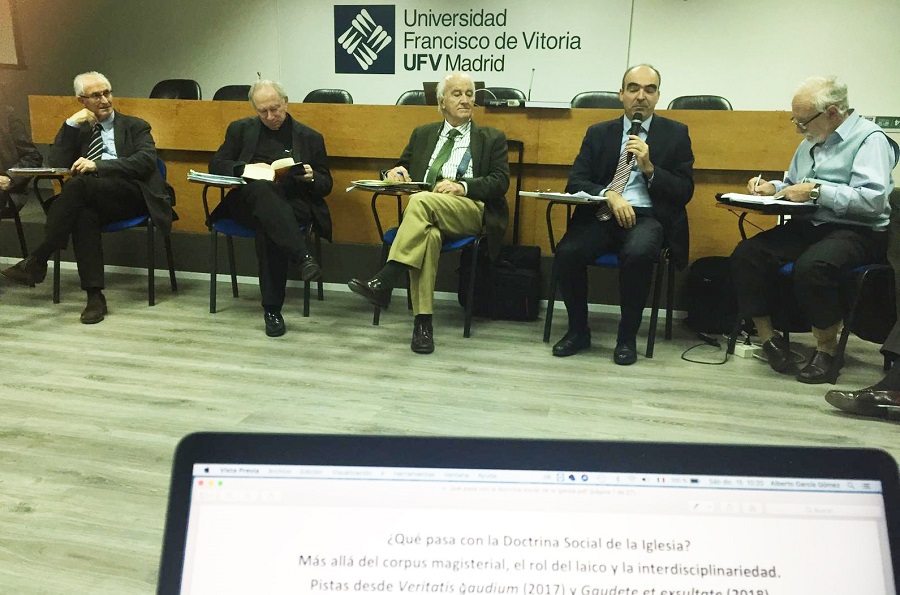
Emilio Martínez Albesa, territorial director of the Lay Consecrated Men of Regnum Christi and a member of the Spanish Territorial Board of Directors, has coordinated the book Ideas on what is happening with the Social Doctrine of the Church (Ideas y Libros Ediciones, 2020). This volume develops the ideas exchanged at a meeting of the Association for the Study of the Social Doctrine of the Church (AEDOS), which took place at the Francisco de Vitoria University in December 2018. Emilio has been a member of this association for almost ten years and in this work seventeen experts seek to answer the question “What is happening with the Social Doctrine of the Church?”. Among the authors we find such important names as Antonio Argandoña, José Andrés-Gallego, Dalmacio Negro Pabón, Juan José Pérez-Soba and Rafael Rubio De Urquía, among others. In order to know a little more in depth the dimension of this book and its actuality we have interviewed Emilio.
What is the problem with the Social Doctrine of the Church: is it losing its relevance?
While the last three Popes have not ceased to invoke the social doctrine of the Church, it has lost weight in university curricula, with very few exceptions. Yes, it is in crisis. For some, it was born as a noble effort that has remained only good intentions. To others, it seems to be an imposition or indoctrination of the Church in matters that are not within its competence. For some, it represents an unmanageable project, since it would be impossible to deal with all social problems. For others, the Church has nothing of value to contribute to the social sciences in order to improve this world. Moreover, many doubt that this doctrine has a specificity within the whole of theological studies. But, above all, we believers need to take seriously the dialogue between the Gospel and culture, between faith and reason, between theological thought and economic, political and social thought, between evangelizing action and humanizing action. Without a Catholic social doctrine that is thought out and lived, it is impossible to evangelize society.
For most of us, the DSI is linked to recent popes, especially John Paul II (Laborem exercens, Solicitudo rei socialis & Centesimus Annus), and Benedict XVI (Caritas in veritate), but with Pope Francis, new challenges have arisen, especially since Evangelii Gaudium & Laudato si’. What new challenges does the current Pope pose for us?
The Holy Father challenges our conscience in a way that is both incisive and deeply respectful, appealing to our honest discernment. He reminds us that all our neighbors are our brothers and sisters, that we all need to care for one another, that the whole of creation is entrusted to us, that we cannot love God without serving our brothers and sisters, that there is no true social improvement if it does not benefit the least of those whom arrogance and indifference allied together condemn to silence and darkness. We all need others to take care of us and others need us to take care of them.
The COVID-19 crisis has highlighted this. The promotion of a culture of care, of inclusion, of love, of the fraternal joy of the Gospel, requires the commitment of every believer to what Francis calls “integral ecology”. This is nothing other than the grateful acceptance of that inheritance received from God and from our elders, which is our world and society - with its values and its difficulties - in order to transmit it to present and future generations, improved by our responsible, creative and generous participation.
Our house has a global, universal dimension, and we must think and live in this dimension. No drama is alien to us: that of the migrant, the unborn child, the kidnapped, the persecuted, the abused, the elderly infected with COVID, the ideologized, the instrumentalized in one way or another. The “common home” must be a home ever more worthy of the children of God. For this reason, an integral ecology contemplates creation with God's eyes, aspiring that all of it, through people and together with them, be so just, good and beautiful that it gives glory to God.
So, as you explain to us, who are those directly involved in the Social Doctrine of the Church, and is there not a risk of remaining in a reflection that does not reach society?
A central theme of the book is the role of the Catholic laity in the production of the Church's social doctrine. The laity is the apostle of Christ sent to evangelize society and the world as leaven in the dough. He must not only apply the social doctrine, but he must also think it, generate it, assimilate it; he must make it his own way of thinking so that it becomes his characteristic way of living. The protagonist must undoubtedly be the lay person. The social doctrine is interdisciplinary and, for this reason, it requires people who are well formed theologically and experts in the social sciences that build our daily environment. Only if believers rethink these human sciences through dialogue between reason and faith and allow themselves to be moved by charity, will social doctrine flourish in evangelizing contributions to the world capable of anticipating the Kingdom of God.
*****
If you want to buy the book in paper or e-book format, go to the following addresses:
E-book:
https://www.elcorteingles.es