By P. Celso Júlio da Silva, LC
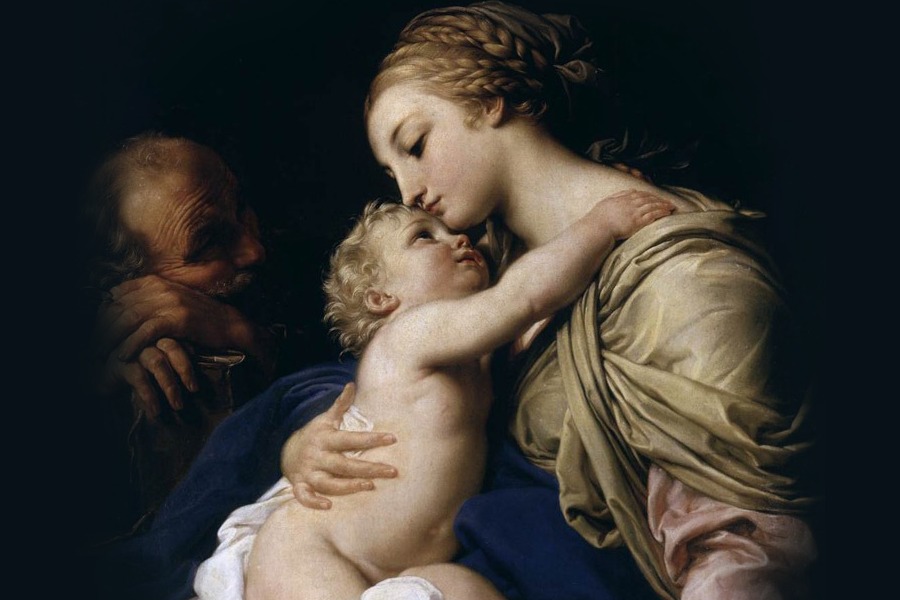
Before the manger, while the human heart longs to contemplate God, God then grants a sign: “you will find a child wrapped in swaddling clothes and lying in a manger” (Lc 2, 7).
God always insists that we ask for signs like this when he said to Ahaz: “Ask for you a sign from Yahweh your God, either in the deepest part of the earth or above, in the highest part of it!” (Is 7, 11). The prophet Isaiah then announces the sign that dwells in the heavens and descends to the depths of the earth: “Behold, a maiden is with child and is about to give birth to a son, whom she shall call Emmanuel” (Is 7, 14). Asking for a sign and receiving it with a simple heart like that of the shepherds of the gospel entails recognizing that this sign reaches from the highest in the heavens to the deepest in the earth of our heart.
What then is the highest and the deepest that is presented as a sign for men? The evangelist Luke points to the presence of that sign in the highest and in the deepest: “Glory to God in heaven, and on earth peace to those whom the Lord loves” (Lc 2, 14). Glory and Peace touch each other in the cradle of Bethlehem. Glory in the highest and Peace in the deepest, behold the sign of the one who rests in the manger.
Admirably, Origen, the great teacher of the patristic period, comments thus on the immensity of God: «The sign proposed is my “Lord” Jesus Christ! (...) In the deep since “he is the one who descended”, and also “in the high”, since “he is the one who ascended above the heavens”. However, as far as I am concerned, this “sign” ... is of no use to me if it does not become for me the mystery of his “deep” and of his “lofty”. When I have accepted the mystery of Christ Jesus, in his “deep” and “his lofty”, then I will receive the “sign” according to the precept of the Lord... If there is anyone who knows how to make use of spiritual consideration, let him understand that the expression: “in the deep and in the lofty” is not said as presenting an alternative; it means precisely that he embraces one and the other» (Origen, Homilies in Isaiah, II, 1). Thus, to welcome this sign is to welcome into our hearts Christ, who deserves Glory and brings us Peace.
This Christmas it is useless for us to sing the Glory of God in heaven and his Peace among men, if the mystery of his coming does not enter our hearts. The mystery of a God who inhabits the heavens and comes to pitch his tent among us (cf. Jn 1, 14) is welcomed in its entirety. The Glory of God goes hand in hand with the Peace that men long for and strive to establish among themselves by the grace of God's presence.
What good does it do us to know that the Word became flesh if we have not embraced his glory and his peace by embodying it in our lives, in our world at war, in our family, in our surroundings? To welcome the sign like the shepherds means to place our hope in a Child who has fallen into the furrow of this earth like a light morning dew. His presence in the depths of our human existence is the joy of a hope that does not disappoint. With the psalmist, with God's embrace of all creation: “Let the heavens rejoice, let the earth be glad, let the sea roar, and all that fills it; let the fields and all that is in them cheer, let the trees of the forest shout. Before the Lord, who is coming, he is coming to rule the earth; he will rule the earth in righteousness and the peoples in faithfulness” (Salt 96, 11-12. 13).
It is clear that asking for signs is very easy, but receiving signs implies much docility. It is not in vain that humble shepherds were given the grace to see such a sublime sign in the depths of a cave. No one can contemplate the greatness of God if he does not have the humility to seek him in the simplicity of a cave, where there is only “a child wrapped in swaddling clothes and lying in a manger”. Humility before the manger is the only key that can open the door of faith for every Christian to see “the loftiness and depth” of God in the tender flesh of a Child. After all, we cannot fully understand God, especially if our eyes only see a little child.
However, with the humility to ask for a sign and to accept it in faith, we can then approach Bethlehem recognizing the greatness of God in the humble manifestation of a birth that is not at all showy. For in this, Cassiodorus was right when he affirmed that “too much greatness is to understand his littleness” (Cassiodorus, De anima c. 11). Yes, if we are humble, the littleness of a Child will enlarge our soul and we will accept that the lofty and the profound have agreed on this Christmas. Yes, too much greatness is to understand his littleness, that is to say, the one who is born is immense because he has assumed the narrowness of the human. This being so, it is understandable that eternity embraces time; if it were otherwise, it would be not only difficult to believe, but even to understand.
Glory and Peace. The sign lying in a manger that we see with the humble eyes of faith is the Lord of Heaven and Earth, of the lofty and the profound, of the Glory he deserves as God and of the Peace he brings to men. But at this rate we do not have to think of peace on a grand scale - although we need it more than yesterday - it is enough to take a look around us. Indeed, it is enough to take a look inside ourselves. Is there peace? Really, is there peace in the depths of our soul?
That God who embraces the highest of heaven is the same God who this Christmas wants to embrace the deepest and most recondite of your heart. He wants to unite the glory that you give him today to the peace that you need and perhaps you do not know how to ask him for it. As we approach the manger for another year, let us allow this Child, as a sign from heaven, to embrace our divided and discordant life. Ask for the grace of peace within your soul, for that Child wants to be Lord also of the deepest part of your being, there where only you enter with Him.
What good is that Child lying in a manger for another year if you do not let him embrace you with his peace? Ask for a sign for yourself, as Ahaz asked for a sign for himself! Why do you ask for so many material gifts every Christmas and always end up empty and unsatisfied? Because to ask for the essential is for noble souls. It requires only a humble heart, like that of the shepherds, who do not ask so many questions or put buts before the mystery of his birth. The peace that this world needs and that we also long for is at the same time the glory of God.
When we recognize in our brothers and sisters their dignity and value in the eyes of God; when we respect the rights of a people, of a nation, of a culture; when we understand and integrate the differences of opinion, of ways of thinking and of doing things; when we listen with respect and attention to those who need to unburden themselves; when we give a little of our time to those who need it; when we know how to silence what could be a bomb capable of hurting or killing our family, our community, our neighbor; when we complain less and give thanks more, is when we give glory to God and there is peace on earth.
Today before the manger a sign has come down from the highest in heaven. Only the humble of heart can be embraced to the depths of the soul by the Son of God who has come to touch the depths of our humanity. He is the Glory and He alone offers us Peace. His flesh is the only source of peace that will put an end to hatred and war. In His tender and fragile flesh, may all who suffer today find a place, a rest and a meaning in the midst of suffering. He alone is our hope and our peace!
Merry Christmas!
______________________
Other reflections by Fr. Celso Julio da Silva: