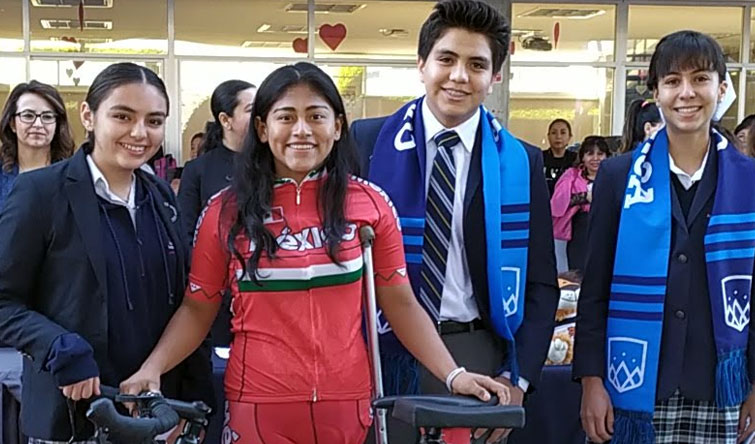
Gilda Andrea Hernández Ramírez is one of the great realities and promises of Mexican para-cycling. She has achieved, among other things, to attend a Paracycling World Championship in Holland, as well as to be champion in the National Olympics in time trial and road events, with the possibility of being part of the Mexican delegation that will attend the next Paralympic Games in Tokyo 2020. The medalist suffered cancer, which resulted in the loss of one of her legs. This has not prevented her from continuing with her dreams, becoming a selected Mexican athlete.
Among the needs he had was to increase his safety and speed while running by creating a support for his bicycle. In this context, high school students from Instituto Cumbres Oaxaca developed a joint project with Gilda as part of the Social Tech Contest of the First Semper Altius Award.
The development of the project was carried out in the Laboratory STEAM-Makerspace Anahuac High School where they designed and prototyped the support. This by means of 3D modeling and printing software.
As a second part of the process, they made the connection between the prosthesis itself and the bicycle, with recycled materials such as stems and seat posts, which they adapted to Gilda's real measurements. This with the support of their advisors, Professor David Cruz and engineer Erik Francisco in STEAM (Science, Technology, Engineering, Art and Mathematics).
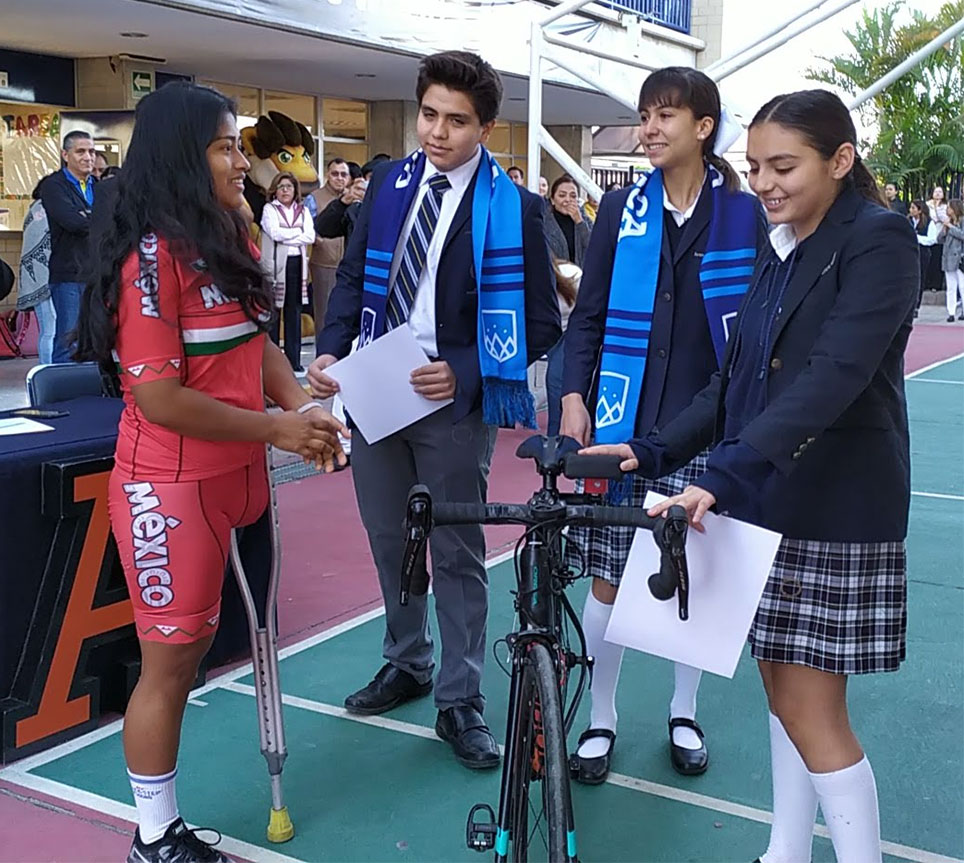
The result is very positive, since after the implementation of the bracket, Gilda was able to increase her average speed from 43 km per hour to 53 km per hour. On Monday, February 17, high school students Arantza Castro, Regina Torres and Jorge Perez, formally delivered the support they designed to Gilda, which is expected to allow her to obtain a better performance and represent our country with greater elements in international competitions in which she is invited.
The social commitment of the students of Instituto Cumbres Oaxaca and the knowledge obtained in STEAM subjects allows them to provide solutions to the needs that arise in Oaxaca and Mexico.
For more information on the project: https://sites.google.com/view/sbpd/p%C3%A1gina-principal?
Source: Cumbres Oaxaca Institute