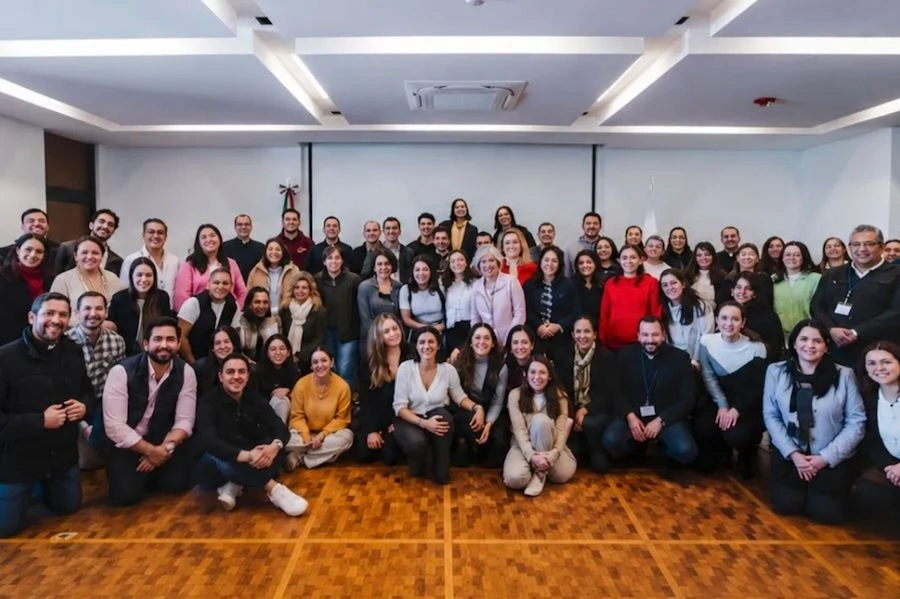
Fabiola and Patricia, consecrated members of Regnum Christi, with the 44 Ukrainians served by Altius
- Fabiola Marton and Paty Sanchez are two of the two consecrated members of Regnum Christi who have been voluntarily living with and helping the refugees in every way possible.
- “Yuliia is a hairdresser and we are immensely happy because she has already found a job in the village hairdresser's shop.”.
- “The health center took very good care of us and the school adapted and made a welcome party for the children.”.
- “Volunteers come from Madrid for transfers to the police or other administrative issues. They dedicate their time for everything they need.”.
Another great help from Altius has been to manage the of hundreds of people to Spain. Drawing up lists of displaced persons, hiring transportation, and once in Spain, finding homes and communities or host families, as well as helping them with the bureaucratic procedures.
Finding shelters for these people is proving to be a great challenge. In Cifuentes, a town of 1,600 inhabitants in Guadalajara, 44 Ukrainians have been sheltered in a house that Hakuna has given to Altius for a few months. It is the former Convent of Our Lady of Bethlehem. At the moment there are 21 women, 6 men, 6 young boys and 11 young girls, in total 19 families.
Their maintenance has been the responsibility of Altius since they arrived in Cifuentes at the beginning of April: electricity, water, food... But the most important thing, it could be said, is the maintenance of peace and morale. Two consecrated women from Regnum Christi, who volunteered to accompany them during the first weeks of adaptation, have been in charge of this. Fabiola Marton and Paty Sanchez tell us in the following interview conducted by Tamara Garcia, of the Altius Foundation, the details of the day-to-day life of these 44 people who have gradually become one big family.
What is the profile of these families?
Most of the group is from the part near Russia. From what we have been told, there are children whose schools no longer exist. Many come from destroyed areas. They are all here with the uncertainty of what will happen. The women have their husbands in Ukraine, in some cases also their older children. They are educated people with very diverse studies and professions: sales clerks, beauticians, teachers, economists, civil servants, seamstresses, architects... among the older men, there are engineers and builders.
How was the arrival of the Ukrainians and your first impressions?
When they arrived they had faces that expressed insecurity, fear, uncertainty and even anxiety. Not everyone in the group knew each other, but there were groups of friends, people who had joined together to face the departure from Ukraine and to help each other. Even so, the arrival in a small town in the interior of Spain, in a very old convent whose exterior is half under construction and the interior half equipped, has not been easy for anyone. So the moment to start was difficult. We practically lacked everything and they came loaded with very difficult war experiences. Most of them had been traveling for 5 to 7 days to get to Cifuentes, so fatigue was also an important factor.
How do you organize your daily life? Cleaning, food, classes...
In general, they have organized themselves in the distribution of household responsibilities. They clean every day and take turns. There is a common kitchen and each family prepares its own food. There are times when they cook for everyone, such as when there is a birthday or any other small celebration.
Yuliia is our kitchen coordinator, she is a spectacular woman. She receives the food that arrives from Altius, distributes it in groups and coordinates the pantry.
Managing food for 44 people is not easy, especially when everyone has their own tastes and habits. Yuliia is also a hairdresser and we are immensely happy because she has already found a job at the hairdresser's in the village. Also, once or twice a week Pepe, a local man who is a cook, comes and prepares Spanish food for us. The rest of the days we eat very tasty Ukrainian food.
As for classes, we are fortunate to have a Spanish teacher in the morning who is Ukrainian, lives in the village and speaks Spanish well and knows how to teach the language. She is Darya, who helps in the Spanish classes and is also present to act as a bridge and give us advice. She teaches us from Monday to Friday from 9:30 to 11:00, although she always goes longer because she sees that people are very thirsty to learn the language. On Wednesday afternoons Juan, the teacher from the local adult school, gives us classes. He gives them for us free of charge. Many Ukrainians are already learning the language so between that and Google translate we are getting by.
But not everything has been easy for you as coordinators.
No! In fact, the beginning was full of difficulties, emergencies, conflicts, lack of foresight, things that were not discussed and that created friction and false expectations. It is understood that it is an emergency situation and the unforeseen events and the needs of the families have been many and very diverse. The arrival was very rushed and everything was half done, both in terms of cleaning and tidying up, and at the beginning there was a shortage of manpower. Thanks to God and all the help we have received, little by little the situation improved.
How was the town's reaction to these new neighbors?
Simply awesome. We were quickly helped to get the most basic things. Some of the Ukrainians arrived with a small suitcase, others with just a plastic bag, others with nothing at all. But every person and organization in the village went out of their way to get what we lacked. We received blankets, heaters, enough glasses and cutlery, shoes, bedding and a long etcetera.
The mayor, Marco Campos, has been present every step of the way, helping the families to settle in. He has been a key figure and always available. In the first few days he gave us a tour of the town with a tour guide and translator. The library was quick to buy a Russian-Spanish dictionary. The bakery in Cifuentes has been giving us bread every day since we have been there.
The health center took very good care of us, impressive service at every moment. The school and the institute adapted and made a welcome party for the children. They received backpacks, materials for classes of all kinds, Spanish classes, teachers who do double duty to help the Ukrainians... The kindergarten was very attentive to welcome us.
A few days after our arrival, there was a concert in the village church to benefit these families. On Book Day we read in the village auditorium two stories in Spanish and also in Russian. Afterwards there was the possibility to buy books and the income again went to Ukraine.
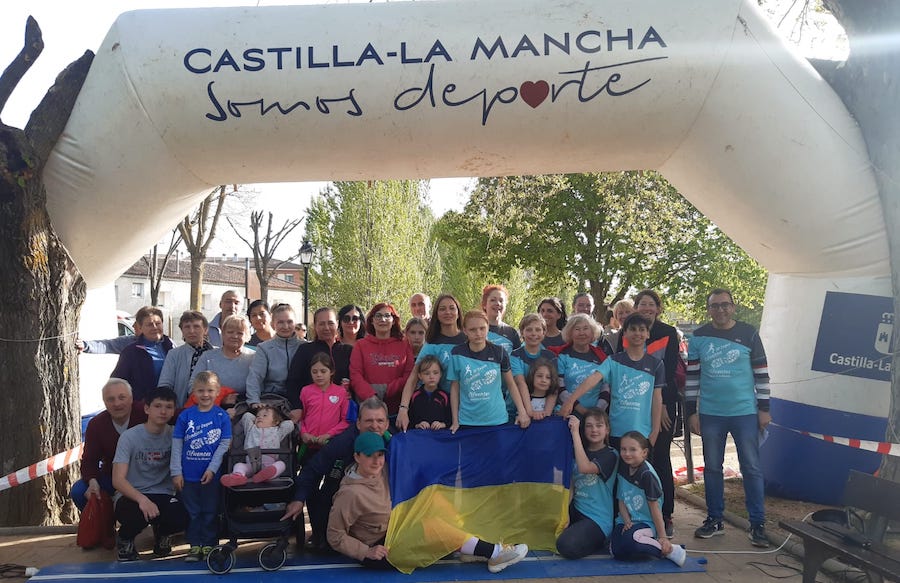
During this time we have also participated in a family marathon of six kilometers, a great event and of much enjoyment and union with the people. We were given T-shirts and this made us feel very clearly that we were already part of Cifuentes. We have no words to thank each of the neighbors for what they have done for all the Ukrainians. Everyone is aware that there are many people behind us helping.
Most Ukrainians are people of faith
Yes, most are Orthodox and practicing in one way or another. We have celebrated Easter twice. Once on the date according to our tradition helping with the steps of the parish of Cifuentes, something really beautiful and integrating, and again on their date, which is a week later. In addition, we have inaugurated a “chapel” in the house with two icons. One of them is the icon of St. Nicholas, painted by a seminarian from Madrid and bought and given to us by a girl student of San Damaso. St. Nicholas is an important saint for the Ukrainian people and they go there to put candles and pray.
From whom else is the assistance received?
Of course from Altius, not only all the food comes from the foundation, whenever a material need arises, be it glasses, medicine, even a bilingual bible... Altius is there. They know that it is the foundation who has brought them and welcomes them, who helps with the paperwork with the embassy, organizes the cultural outings and who looks for volunteers for other tasks.
Nor can we forget the Everest School Monteclaro that gave us one of their buses to do various procedures and the immense help of the volunteers who come from Madrid for the many transfers that we have needed either to the police in Guadalajara, for the appointments for the application for temporary protection, or the arrival of the Ukrainians to Cifuentes. They sacrifice a whole morning to accompany them in the formalities, then invite them for coffee, spend time with them and give them their time with great generosity, warmth and affection that, without a doubt, is noticeable at every moment.
The Hakuna association that has lent the house and made all this possible. In addition, their volunteers have organized cooking and painting workshops on the weekends. They have also helped with the logistics and organization of the house by sticking posters with translations to know where the hygiene items, medicines and kitchen utensils are. And in other needs that arose, such as setting up the rooms when they arrived.
The hotel group Atelier Petit Palace has bought us suitcases, food and many hygiene products. Fr. Jacobo Portillo, LC, and his group made a donation of meat and various things. Many people have donated food, meat, cell phones, sunglasses, clothes of all kinds... Uncountable. And we are forgetting things for sure.
Undoubtedly, the help that each one has been putting at the service of the Ukrainian families, has made all this go ahead and make it a more complete and beautiful help, because somehow this makes and allows to continue doing a ‘charitable’ work with many hands and many hearts.
Finally, what is the next challenge for this community that has been formed?
Now the important thing is to help each and every one of them to achieve an autonomous life and for this it is essential that they find a job. We receive good news every day. Five of them are going to work at Panificadora Alcalá and many others are already moving around the area to find work.
Hopefully they can rebuild their lives here. Many are waiting for the conflict to end so they can return to their country, but in the meantime, they know that they have a home here too.