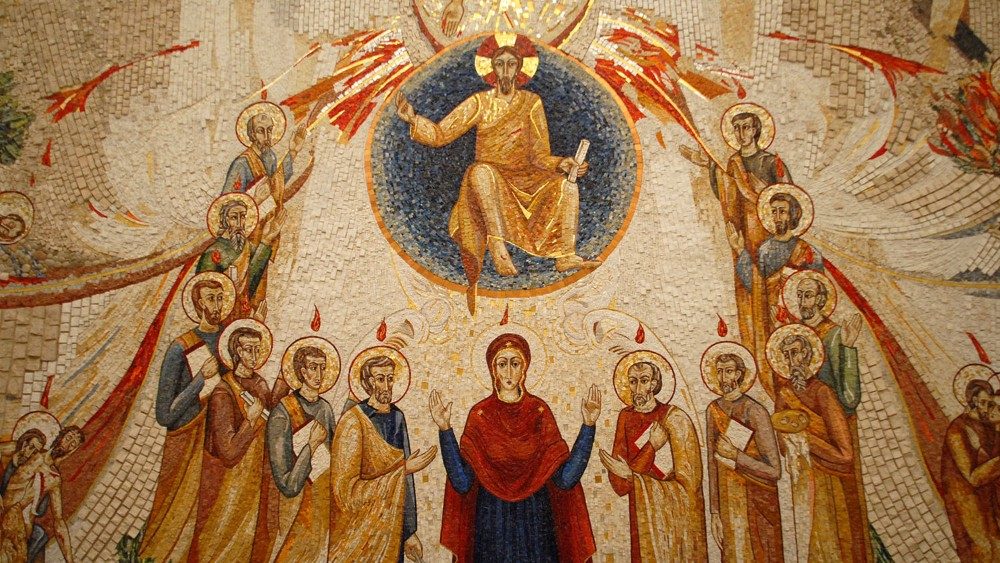
For its richness of content, we transcribe below the homily of Pope Francis on the day of Pentecost published on the official site Vatican.Va.
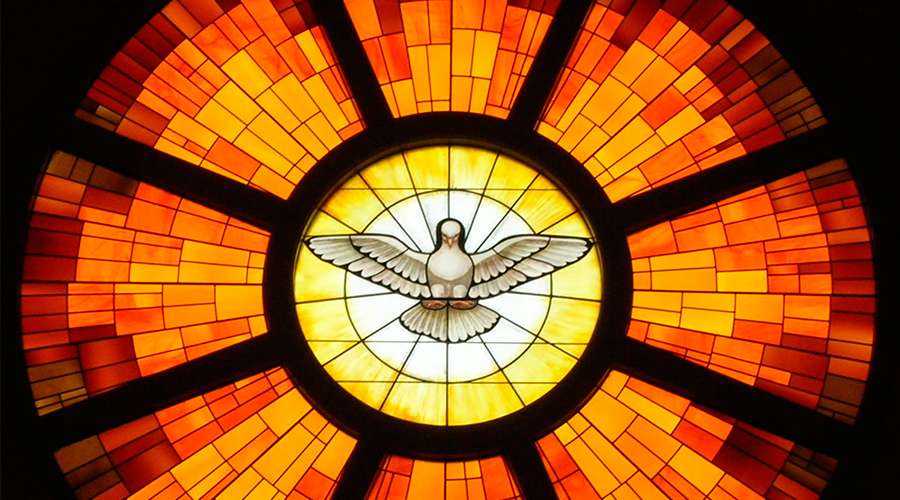 «There are diversities of charisms, but the same Spirit» (1 Co 12,4). Thus writes the apostle Paul to the Corinthians; and he goes on to say: «There are diversities of ministries, but the same Lord; and there are diversities of actions, but the same God» (vv. 5-6). Diversity and unitySt. Paul insists on joining two words that seem to be opposed to each other. He wants to indicate that the Holy Spirit is the unit that brings together the diversity; and that the Church was born this way: we, diverse, united by the Holy Spirit.
Let us go, then, to the beginning of the Church, to the day of Pentecost. And let us look at the Apostles: many of them were simple people, fishermen, accustomed to living by the work of their own hands, but there was also Matthew, a learned tax collector. There were different origins and social contexts, Hebrew names and Greek names, gentle and impetuous characters, as well as different points of view and sensibilities. They were all different. Jesus had not changed them, had not made them uniform and turned them into mass-produced specimens. No. He had put aside their differences and, now, anointing them with the Holy Spirit, unites them. The union -the union of diversity - is realized by the unction. At Pentecost the Apostles understood the unifying power of the Spirit. They saw it with their own eyes when all, though speaking different languages, formed one people: the people of God, shaped by the Spirit, who weaves unity with our diversity, and gives harmony because in the Spirit there is harmony..
But returning to us, the Church of today, we can ask ourselves: “What is it that unites us, what is the basis of our unity? There are also differences among us, for example, of opinion, of choice, of sensitivity. But the temptation is always to want to defend one's own ideas to the hilt, considering them valid for everyone, and to get along only with those who think the same way as us.. And this is an ugly temptation that divides. But this is a faith built in our image and it is not what the Spirit wants. Consequently, we might think that what unites us is the same thing we believe and the same way of behaving. However, there is much more to it than that: our principle of unity is the Holy Spirit. He reminds us that, first and foremost, we are beloved children of God; We are all equal in this, and all different. The Spirit descends upon us, in spite of all our differences and miseries, to show us that we have only one Lord, Jesus, and only one Father, and that for this reason we are brothers and sisters. Let us start again from here, let us look at the Church as the Spirit looks at it, not as the world looks at it. The world sees us of the right and of the left, of this or that ideology; the Spirit sees us of the Father and of Jesus. The world sees conservatives and progressives; the Spirit sees children of God.. The worldly gaze sees structures that need to be made more efficient; the spiritual gaze sees brothers and sisters who are beggars for mercy. The Spirit loves us and knows the place that each of us has in the whole: for him we are not confetti blown by the wind, but irreplaceable tesserae of his mosaic.
Let us go back to the day of Pentecost and discover the first work of the Church: the advertisement. And, even so, we notice that the Apostles did not prepare any strategy; when they were enclosed there, in the cenacle, they did not elaborate a strategy, no, they did not prepare a pastoral plan. They could have divided the people into groups, according to their different towns of origin, or they could have gone first to those closest to them and then to those far away; they could also have waited a little before beginning the proclamation and, in the meantime, they could have gone deeper into the teachings of Jesus, to avoid risks, but they did not. The Spirit did not want the memory of the Master to be cultivated in closed groups, in cenacles where we take pleasure in “nesting”. And this is an ugly disease that can enter the Church: the Church not as a community, not as a family, not as a mother, but as a nest. The Spirit opens, revives, pushes us beyond what has already been said and done, He takes us beyond the spheres of a timid and distrustful faith.. In the world, everything falls apart without solid planning and a calculated strategy. In the Church, on the other hand, it is the Spirit who guarantees unity to those who proclaim. That is why the apostles set out, unprepared, taking risks, but they succeed. They are animated by a single desire: give what they have received. The beginning of the First Letter of St. John is beautiful: “What we have received and seen we proclaim to you” (cf. 1:3).
We finally came to understand what the secret of unity is, the secret of the Spirit. The secret of unity in the Church, the secret of the Spirit is the gift. Because He is gift, lives by donating himself and in this way keeps us united, making us sharers in the same gift.. It is important to believe that God is a gift, that he does not act by taking, but by giving. Why is this important? Because our way of being believers depends on how we understand God. If we have in mind a God who snatches, who imposes himself, we too would like to snatch and impose ourselves: occupying space, claiming relevance, seeking power. But if we have in our hearts a God who is a gift, everything changes. If we realize that what we are is his gift, gratuitous and undeserved, then we too would like to make life itself a gift. And in this way, loving humbly, serving freely and joyfully, we will give to the world the true image of God. The Spirit, living memory of the Church, reminds us that we are born of a gift and that we grow by giving ourselves; not by preserving ourselves, but by giving ourselves without reserve..
Dear brothers and sisters: Let us examine our hearts and ask ourselves what it is that prevents us from giving ourselves. We say that there are three main enemies of the gift: three, always crouching at the door of the heart: narcissism, victimhood and pessimism. The narcissism, The narcissist thinks: “Life is good if I get advantages”. The narcissist thinks: “Life is good if I get advantages". And so he goes so far as to say to himself: "Why should I give myself to others?”. In this pandemic, how much narcissism hurts, worrying about one's own needs, indifferent to those of others, not admitting one's own frailties and mistakes. But also the second enemy, victimhood, is dangerous. The victimizer is always complaining about others: “No one understands me, no one helps me, no one loves me, they are all against me! How many times have we heard these lamentations! And his heart closes, while he wonders: ”What is it?Why don't others donate to me??”. In the drama we are living, how serious is victimhood! To think that there is no one who understands us and feels what we are going through. This is victimhood. Finally, there is pessimism. Here the daily litany is: “Everything is wrong, society, politics, the Church...”. The pessimist lashes out at the whole world, but remains apathetic and thinks: “I am a pessimist.“In the meantime, what is the use of giving oneself? It is useless”. And so, in the great effort of starting over, how harmful is pessimism, seeing everything black and repeating that nothing will ever be as it was before. When you think like that, what surely does not come back is hope.. In these three - the narcissistic mirror idol, the mirror god; the lamentation-god: “I feel like a person when I lament”; the negativity-god: “everything is black, everything is darkness” - we find ourselves before a shortage of hope and we need to value the gift of life, the gift that is each one of us. For this reason, we need the Holy Spirit, God's gift that heals us from narcissism, victimhood and pessimism, heals us from the mirror, from lamentation and darkness..
Brothers and sisters, let us ask: Holy Spirit, memory of God, rekindle in us the memory of the gift we have received. Deliver us from the paralysis of selfishness and enkindle in us the desire to serve, to do good. Because worse than this crisis, is only the drama of wasting it, locking ourselves in ourselves. Come, Holy Spirit, You who are harmony, make us builders of unity; You who always give of Yourself, grant us the courage to go out of ourselves, to love and help one another, to become one family. Amen.