BENEDICT XVI (1927-2022)
With much sorrow and sadness and at the same time with the Christian hope and joy of the resurrection, we ask in our prayers for the eternal rest of Benedict XVI. To him we owe much, because under his pontificate and paternal tutelage, through his Pontifical Delegate, he guided us in the difficult years of making the truth about our history and we began our processes of revision and renewal of the charism of the entire Regnum Christi family. May he rest in peace!
You will be able to find here the complete letter of the General Direction College of Regnum Christi.
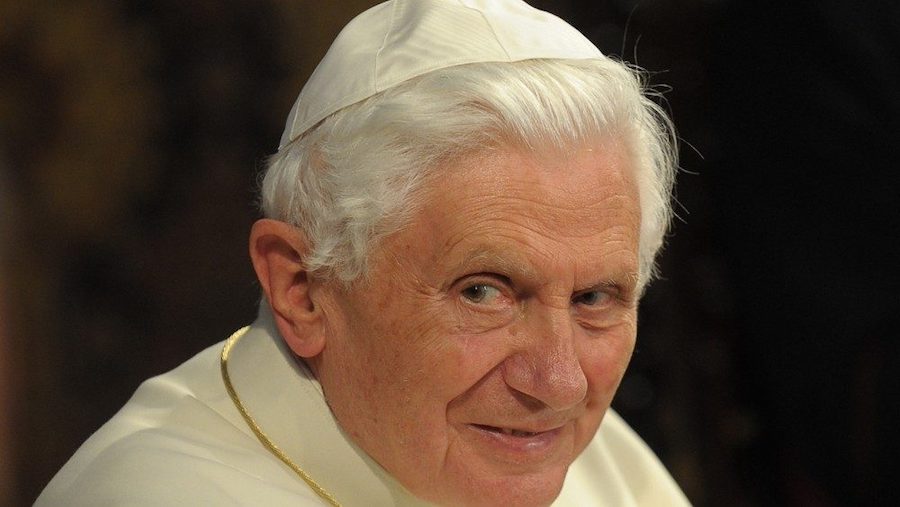
Cardinal Joseph Ratzinger, Pope Benedict XVI, was born in Marktl am Inn, Diocese of Passau (Germany), on April 16, 1927 (Holy Saturday), and was baptized on the same day. His father, a gendarmerie commissioner, came from an old farming family in Lower Bavaria, with rather modest economic conditions. His mother was the daughter of craftsmen from Rimsting on Lake Chiem, and before her marriage she worked as a cook in several hotels.
The period of his youth was not easy. The faith and education of his family prepared him to face the hard experience of those times, in which the Nazi regime maintained a climate of strong hostility against the Catholic Church. The young Joseph saw how the Nazis beat the parish priest before the celebration of Holy Mass.
Precisely in that complex situation, he discovered the beauty and truth of faith in Christ; fundamental to this was the attitude of his family, who always gave a clear testimony of goodness and hope, rooted in a conscious belonging to the Church.
From 1946 to 1951 he studied philosophy and theology at the Freising School of Philosophy and Theology and at the University of Munich.
He was ordained to the priesthood on June 29, 1951.
In 1953 he received his doctorate in theology with the thesis: “People and House of God in the doctrine of the Church of St. Augustine”.
After serving as professor of dogmatic and fundamental theology at the Freising School of Philosophy and Theology, he continued his teaching activities in Bonn from 1959 to 1963, in Münster from 1963 to 1966 and in Tübingen from 1966 to 1969. In the latter year he became professor of dogmatics and history of dogma at the University of Regensburg, where he also held the position of vice-president of the University.
From 1962 to 1965 he made a notable contribution to the Second Vatican Council as an “expert”; he served as theological consultant to Cardinal Joseph Frings, Archbishop of Cologne. In 1972, together with Hans Urs von Balthasar, Henri de Lubac and other great theologians, he started the theological journal “Communio”.
On March 25, 1977, Pope Paul VI appointed him Archbishop of Munich and Freising. On the following May 28 he received his episcopal consecration. He was the first diocesan priest, after 80 years, to assume the pastoral government of the great Bavarian archdiocese. He chose as his episcopal motto: “Collaborator of truth”. He explained: “On the one hand, it seemed to me that this was the connection between my previous task as a teacher and my new mission. In spite of the different ways, what was at stake and remained at stake was to follow the truth, to be at its service. And, on the other hand, I chose that motto because in today's world the subject of truth is almost totally omitted, for it seems too big a thing for man and yet everything falls apart if truth is missing.”.
Paul VI created him a cardinal, of the presbyteral title of St. Mary of Consolation in Tiburtino, in the consistory of June 27 of the same year.
John Paul II appointed him prefect of the Congregation for the Doctrine of the Faith and president of the Pontifical Biblical Commission and the International Theological Commission on November 25, 1981. On February 15, 1982, he resigned from the pastoral government of the Archdiocese of Munich and Freising. He was elevated to the order of bishops, assigning him the suburbicarian see of Velletri-Segni on April 5, 1993.
He was president of the commission for the preparation of the Catechism of the Catholic Church, which, after six years of work (1986-1992), presented the new Catechism to the Holy Father.
He was elected Pope on April 19, 2005 and chose the name Benedict XVI. When he introduced himself to the crowd on the main balcony of St. Peter's Basilica, he said he was “a simple and humble worker in the vineyard of the Lord.”. During his pontificate he wrote 3 encyclicals: Deus Caritas Est (2005), Spes Salvi (2007) y Caritas in Veritate (2009).
During his pontificate he was also the author of countless works, among which the three volumes on the life of Jesus of Nazareth stand out. There is also a rich range of theological thought, in different languages, in books on his homilies, speeches, reflections, catecheses and interviews.
During his seven and a half years as pope, he made 24 official trips. On December 12, 2012, Benedict XVI sent his first tweet to the digital world, creating the first Twitter account for a pope.
«I have come to the certainty that my strength, because of my advanced age, is no longer suited to the exercise of the Petrine ministry. With complete freedom I declare that I renounce the ministry of Bishop of Rome and successor of Peter.», These were the words of February 11, 2013, when Benedict XVI publicly announced his resignation as Pope, thus becoming Pope Emeritus. He retired to a former monastery, the Mater Ecclesiae, inside the Vatican. From there he continued his life in an atmosphere of prayer and silence, with some public interventions with Pope Francis and also through various writings published by the press.
On December 31, 2022, he died in Vatican City at the age of 95.